Apartment Buildings Are Turning Into Airbnbs and the People Living There Have Almost No Recourse
TL;DR
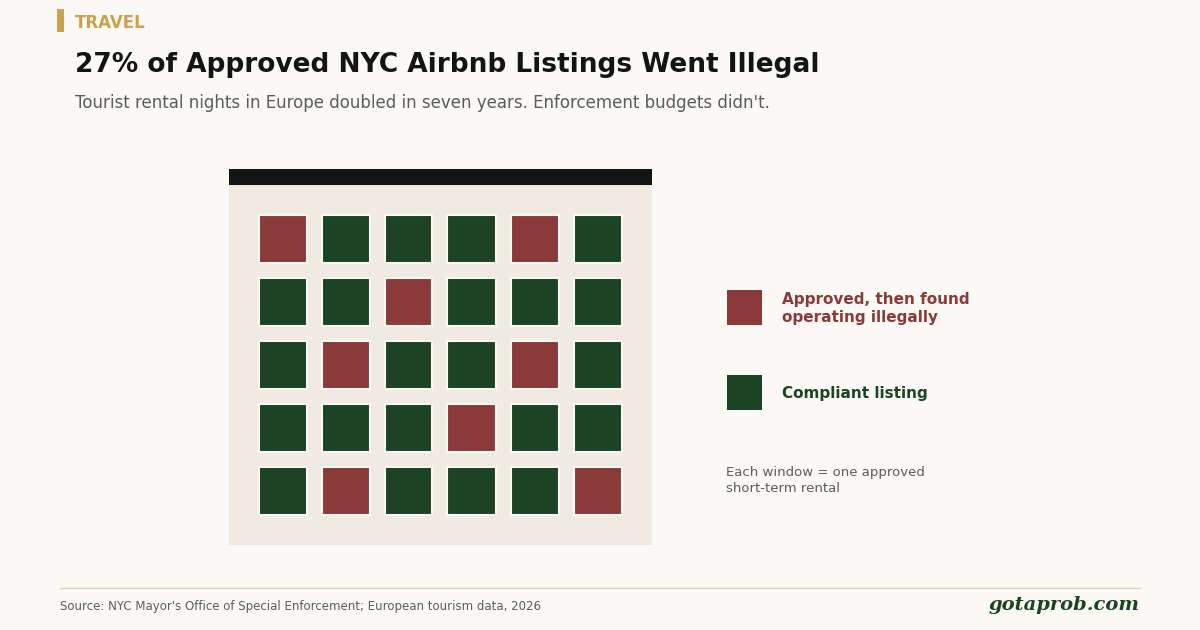
- •27%: Of NYC's approved short-term rental listings are now operating illegally, offering entire homes or exceeding guest limits, according to the city's own Office of Special Enforcement, April 2026, as reported by Skift.
- •€64 million: Fine imposed on Airbnb by the Spanish government in December 2025 for breaches of consumer laws including over 65,000 unlicensed listings, according to World Habitat.
- •398 million: Tourist rental nights booked across Europe in 2025, nearly double the 2018 figure, while enforcement capacity in most cities has not kept pace, according to EU statistics cited by Fortune.
Stay curious
One problem,
every Tuesday.
The most interesting problem of the week, straight to your inbox.
No spam. Unsubscribe anytime.
Want the deeper version?
Problem Desk
Problem Desk is the tracked, ongoing version — scored, sourced, and re-verified over time.
Explore Problem DeskThe building that became a hotel
A resident who moved into a long-term rental apartment building did not expect to share their hallway with a different rotating group of tourists every weekend. They did not expect the elevator to carry rolling luggage at 2am. They did not expect their legal right to quiet enjoyment to be eroded by a landlord running an unlicensed hotel operation above them.
This experience is documented in tenant complaint records and city enforcement actions across New York City, Barcelona, Paris, Edinburgh, and dozens of other cities where residential apartment buildings have been progressively converted into short-term rental stock. The financial incentive is straightforward and documented. According to World Habitat's December 2025 analysis, peer-reviewed research has shown that Airbnb-style rentals raised annual rents in Berlin by 1.3 to 2.7% and drove house prices in Portugal up by an average of 3.7%, with increases of more than 30% in the historic centres of Lisbon and Porto where short-term rentals are heavily concentrated.
How the rules keep failing to hold
New York City enacted Local Law 18 in September 2023. The law required hosts to register with the city, live in the home as a primary residence, stay on site during the visit, and host no more than two guests at a time. Whole-apartment stays where the host is absent were effectively made illegal. According to World Habitat, these restrictions effectively eliminated new commercial Airbnb operations in the city and were designed to preserve residential housing stock.
By April 2026, NYC's own Office of Special Enforcement found that 27% of approved listings were already operating illegally again, primarily by offering entire homes or exceeding guest limits. The city had issued approximately 600 warnings to non-compliant hosts and filed lawsuits against operators who ignored regulations. Airbnb is adhering to Local Law 18 by ensuring hosts are registered at the point of listing. The platform is not required to remove listings that later become non-compliant. Enforcement of ongoing compliance falls entirely to the city.
The NYC government's own enforcement record from 2021 through 2026 documents the pattern precisely. A multi-million dollar lawsuit was filed against a landlord for operating illegal short-term rentals in rent-stabilised buildings in February 2026. NYC filed its first lawsuit using Local Law 18 itself in May 2025. Earlier settlements reached $845,000 and $1.2 million against specific operators. The operations that produced those settlements continued generating revenue during the period between identification and settlement. New violations followed each enforcement action.
The European escalation
The city that has gone furthest is Barcelona. According to World Habitat, the city announced in June 2024 that it would not renew the licences for over 10,000 apartments approved for tourist use once they expire, with the cutoff set for 2028. The goal is to return those homes to residents in a city where rents had soared significantly. Barcelona already enforces some of Europe's strictest rules: short-term rentals are capped at 30 nights per year, hosts must register for a licence, and in several neighbourhoods they are banned entirely.
In December 2025, the Spanish government imposed a €64 million fine on Airbnb for breaches of consumer laws including over 65,000 unlicensed listings, according to World Habitat. That fine, the largest ever imposed on Airbnb by a national government, is itself evidence of the scale of non-compliance that persisted despite regulations nominally being in place.
Fortune's April 2026 coverage of Paris as ground zero for Europe's Airbnb backlash notes that tourist rental nights across Europe nearly doubled between 2018 and 2025 to 398 million according to EU statistics. Paris and other French cities lowered their annual short-term rental limit from 120 days to 90 days in October 2024. The volume of tourist nights continues growing faster than enforcement capacity in most cities.
London introduced its 90-day annual limit in 2015, according to World Habitat, one of the first major cities to regulate in this way. Edinburgh introduced a tourist tax in January 2025 and began a major enforcement campaign against unlicensed short-term lets the same year. Across Europe the pattern is consistent: rules exist, violations continue, enforcement lags.
The structural gap enforcement cannot close
The problem is not that cities lack rules. It is that every enforcement model shares a common failure mode: it requires the city to identify non-compliant operators, notify them, pursue legal action, and collect penalties through a process that takes months or years, while the financial returns from non-compliance continue accumulating daily.
NYC's enforcement record illustrates this directly. The city has won settlements of $845,000 and $1.2 million against specific operators, filed multiple lawsuits, and issued 600 warnings. Each enforcement action is real and produces financial consequences. The 27% illegal operation rate among approved listings, from the city's own partial review, tells you how much of the compliant surface sits on top of ongoing non-compliance underneath.
The resident who lives in a building converting to short-term rentals sits outside this enforcement cycle almost entirely. Reporting to the city requires knowing which agency handles the complaint, navigating a complaint process, and then waiting for an investigation that may take months. Taking personal legal action requires resources most tenants do not have. Leaving the building is available only to tenants who can afford to move.
World Habitat's analysis is direct on the core point: when a significant share of housing is repurposed for tourism, local renters lose out. In New York alone, roughly 50,000 Airbnb-style properties have appeared, resulting in a net loss of approximately 10,000 residential homes, according to peer-reviewed research cited in their December 2025 report. These are homes permanently removed from the long-term residential market. For the residents displaced or disrupted by that conversion, the enforcement actions that eventually follow do not restore what was lost during the period of non-compliance.
Proof signals
NYC Office of Special Enforcement partial review April 2026, reported by Skift. The 27% illegal operation rate among approved listings is the city's own finding from its own enforcement body, not an external estimate. The specific mechanism Skift identifies is that Airbnb verifies registration at the point of listing but is not required to monitor subsequent compliance. The gap between registration and ongoing compliance is where the 27% lives. 600 warnings issued and lawsuits filed confirm the city is acting. The 27% figure confirms that action has not resolved the problem.
NYC government enforcement press releases 2021 to 2026. The city's own enforcement news page documents a continuous pattern of lawsuits, settlements, and new violations across the entire period after Local Law 18 was enacted. The February 2026 lawsuit against a landlord for operating illegal STRs in rent-stabilised buildings, buildings with explicit legal tenant protections, is the most direct documentation of the resident harm the enforcement gap produces.
Spain €64 million fine December 2025, documented by World Habitat. The scale of the fine against Airbnb for 65,000+ unlicensed listings in a country that already had registration requirements confirms that the compliance gap is not marginal. It existed at scale despite mandatory registration being nominally in effect. National-level enforcement producing the largest fine in Airbnb's history has not prevented Barcelona's simultaneous decision to eliminate all tourist apartment licences by 2028.
Fortune EU statistics April 2026. Tourist rental nights in Europe nearly doubling between 2018 and 2025 while Paris simultaneously lowers its annual cap is the clearest illustration of the enforcement dynamics: regulatory intervention is real, is producing stricter rules, and is happening against a backdrop of accelerating volume. The rules are getting tighter. The usage is getting bigger. The enforcement gap persists between them.
World Habitat research synthesis December 2025. The cross-city documentation of regulatory responses across London, Barcelona, New York, Edinburgh, Lisbon, and Porto, combined with peer-reviewed research on rent and price impacts, provides the most credible available overview of the problem at global scale. The organisation's conclusion that regulation is necessary but insufficient, and that lasting change requires comprehensive housing strategies that go beyond managing tourism effects, frames the structural nature of the problem precisely.
What to actually do about it
Existing attempts fall short in specific ways:
- Registration-at-listing requirements (NYC's Local Law 18): Requiring hosts to register when they first list a property eliminated most new commercial operations initially, but it only verifies compliance at the moment of listing. Nothing in the model requires ongoing verification, which is how 27% of approved listings have drifted back into illegal operation without the registration status ever changing.
- Fines and lawsuits after the fact (Spain's €64 million fine, NYC's $845,000 to $1.2 million settlements): These penalties are real and substantial, but they arrive months or years after the violation begins, during which the operator continues collecting short-term rental income. The fine becomes a cost of doing business rather than a deterrent when the revenue during the enforcement gap exceeds the eventual penalty.
- Annual night caps (Barcelona's 30 nights, London and Paris's 90 nights): Capping the number of nights a property can be rented limits the scale of commercial operation, but enforcing the cap requires actually tracking bookings against it, which most cities do not do in real time. A cap that is not actively monitored functions as a suggestion rather than a limit.
- Full licence phase-outs (Barcelona's 2028 elimination of all tourist apartment licences): Eliminating the category entirely removes the detection problem, but it also removes short-term rental housing options for owner-occupiers and occasional hosts who were never the source of the enforcement problem, alongside the commercial operators who were.
- Tourist taxes (Edinburgh): A tourist tax generates revenue that can fund enforcement staff, but it does not by itself reduce the rate of non-compliance. It is a funding mechanism for enforcement capacity, not a substitute for it.
Before going further, it is worth pressure-testing the idea against these questions:
- If registration-at-listing does not prevent drift back into non-compliance, what would ongoing verification actually require, and who would bear the cost of monitoring listings continuously rather than checking once at signup?
- Night caps like Barcelona's 30 nights or London's 90 nights depend on someone tracking actual bookings against the limit. Is there a realistic way to verify compliance with a night cap without either platform-level data sharing or a dedicated monitoring system, and why has neither become standard?
- Peer-reviewed research shows measurable rent and price increases in cities with high short-term rental concentration, in Berlin, Lisbon, and Porto specifically. Does closing the enforcement gap actually reverse those price effects, or has the housing stock loss already become structural in the most affected neighbourhoods?
- Barcelona's full phase-out avoids the detection problem by eliminating the category by 2028, at the cost of removing a housing option some travellers and occasional hosts rely on. Is there a middle path that distinguishes owner-occupied, occasional hosting from full-scale unlicensed hotel operations, and why have most cities not built enforcement around that distinction instead?
- Given that tourist rental nights in Europe nearly doubled between 2018 and 2025 while enforcement budgets did not scale proportionally, is the realistic path forward more government funding for enforcement staff, mandatory platform-level compliance data sharing, or something residents themselves could access and act on directly when they suspect a building near them is non-compliant?
Stay curious
One problem,
every Tuesday.
The most interesting problem of the week, straight to your inbox.
No spam. Unsubscribe anytime.
Want the deeper version?
Problem Desk
Problem Desk is the tracked, ongoing version — scored, sourced, and re-verified over time.
Explore Problem DeskSources
Related Problems
AI Summaries Are Training People to Read the Answer Without Reading the Source
For the first time in the fifteen-year history of the Reuters Institute Digital News Report, social media and video networks overtook news organisations' own websites and apps as t...
Plus Size Clothing Is Disappearing From Stores While the Market It Serves Keeps Growing
The global plus-size women's apparel market exceeded $324 billion in 2025 and is projected to grow to $445 billion by 2032. The majority of US women, 54.4%, wear size 14 or above. ...
USPS Is Running Out of Money and On-Time Delivery Has Dropped to Its Lowest Point in Years
The United States Postal Service is legally required to provide mail delivery service to every address in the country, six days a week, at a uniform price regardless of location. D...