AI Coding Tools Speed Up Simple Tasks by 55% and Barely Move Real-World Productivity
TL;DR
- •55.8%: Faster task completion for developers using GitHub Copilot versus those without it, in a controlled Microsoft Research experiment with 95 developers, on an isolated, well-defined coding task.
- •60%: Positive sentiment toward AI tools among developers in 2025, down from 70%+ in both 2023 and 2024, according to the Stack Overflow Developer Survey 2025 of 49,000+ developers in 177 countries.
- •2x: Increase in advanced questions on Stack Overflow since 2023, according to Stack Overflow's own analysis, indicating that complex, context-dependent problems are the ones AI tools consistently fail to solve.
Stay curious
One problem,
every Tuesday.
The most interesting problem of the week, straight to your inbox.
No spam. Unsubscribe anytime.
Want the deeper version?
Problem Desk
Problem Desk is the tracked, ongoing version — scored, sourced, and re-verified over time.
Explore Problem DeskThe experiment versus the workplace
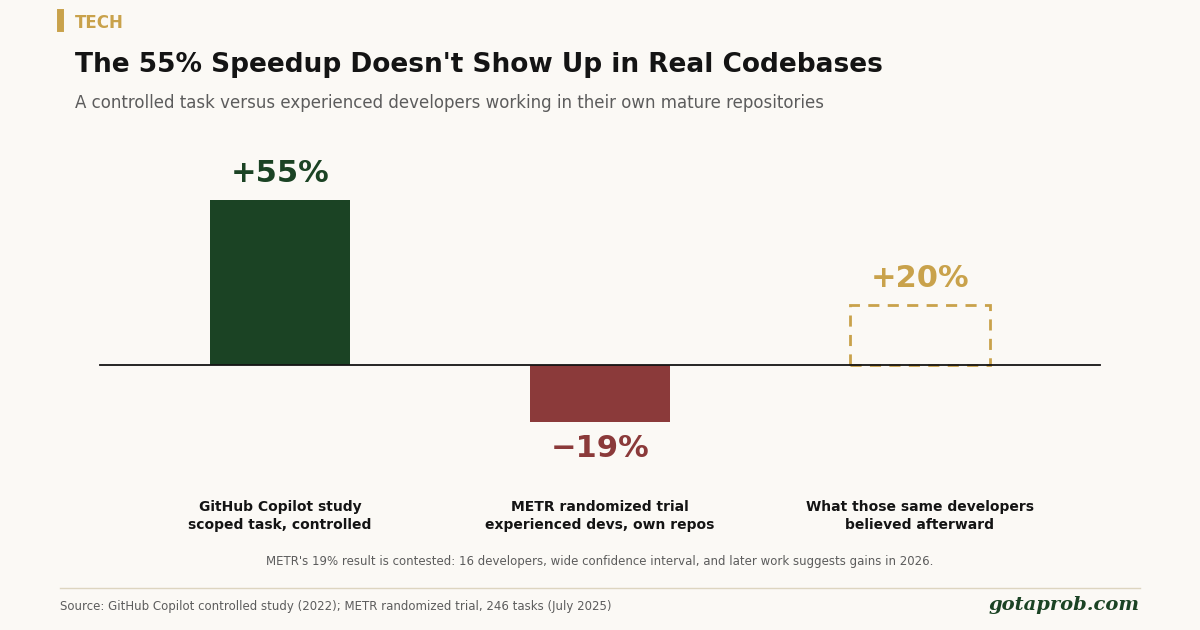
In 2023, Microsoft Research conducted a controlled experiment. Ninety-five professional software developers were recruited and randomly assigned to two groups. Both groups were asked to implement an HTTP server in JavaScript as quickly as possible. The group with access to GitHub Copilot completed the task in 71 minutes on average. The control group took 161 minutes. That is a 55.8% reduction in completion time, one of the largest single-task productivity gains documented in AI-assisted work, according to Microsoft Research's published findings.
The task was isolated, well-defined, and had a clear completion criterion. The developers started fresh with no prior context, no existing codebase to integrate with, no organisational patterns to follow, and no legacy decisions to respect.
Real software development does not look like this.
What the largest developer survey shows
The Stack Overflow Developer Survey 2025 is the most comprehensive annual measurement of how developers actually experience AI tools at work. Conducted across 49,000+ developers in 177 countries, it produces the closest thing available to a ground-level measurement of AI's effect on the profession.
The 2025 results are notable for what is moving in opposite directions simultaneously. AI tool adoption is at its highest point: 84% of developers now use or plan to use AI tools, up from 76% last year, and 51% of professional developers use them daily. At the same time, positive sentiment toward those same tools has dropped from above 70% in both 2023 and 2024 to just 60% in 2025.
More developers are using AI tools. Fewer of them feel good about those tools. Both things are true at the same time.
The Stack Overflow blog analysis of the results identifies two main frustrations driving the trust decline: solutions that are almost right but not quite, generating code that looks correct but fails on edge cases or real-world constraints, and time wasted debugging AI-generated code. About 35% of developers report that some of their visits to Stack Overflow are specifically the result of AI-related issues, meaning the platform that AI tools were supposed to reduce dependence on is seeing increased traffic from people cleaning up AI mistakes.
The advanced question signal
One data point from Stack Overflow's own analysis is particularly revealing. The number of advanced questions on the public platform has doubled since 2023. Advanced questions are the ones that require genuine expertise, context-specific reasoning, and understanding of complex interdependencies, the category of problems where a developer cannot simply describe what they want and receive working code.
The doubling of advanced questions on Stack Overflow at precisely the moment that AI tool adoption reached 84% tells you something specific about where the capability boundary sits. AI tools are handling the straightforward questions, the boilerplate, the syntax, the well-documented patterns, and pushing the volume of genuinely difficult, context-dependent problems to human communities.
According to the Stack Overflow 2025 survey, developers show the most resistance to using AI for high-responsibility, systemic tasks: 76% do not plan to use AI for deployment and monitoring, and 69% do not plan to use it for project planning. These are exactly the tasks that require sustained context across sessions, understanding of how systems interact, and reasoning about decisions made weeks or months ago.
The gap between isolated tasks and real work
The GitHub Blog's own research on GitHub Copilot's productivity impact confirms the controlled experiment finding, 55% faster on isolated tasks, and also documents what developers themselves report: they complete tasks faster especially on repetitive ones, 90%+ agree, and 87% experience less mental effort on repetitive work.
Repetitive work. The phrase matters. The 55% speed gain documented in the Microsoft Research experiment and confirmed in GitHub's own survey is real and meaningful. It applies most clearly to the category of work that is well-understood, clearly scoped, and does not depend on remembering why a decision was made three weeks ago.
The category of work that does depend on that context, integrating with a codebase that has evolved over years, reasoning about why certain architectural choices were made, understanding the constraints that are not written down anywhere, is exactly where developer trust in AI tools is declining. The Stack Overflow survey documents that developers who reported AI tools struggling with complex tasks dropped from 35% in 2024 to 29% in 2025, an improvement, but that improvement exists alongside the overall trust decline, suggesting the tools are getting better at the easy version of complex tasks while the genuinely hard cases remain unsolved.
The willing but reluctant majority
The Stack Overflow blog described the overall picture precisely: developers remain willing but reluctant. The headline from their own analysis of the 2025 results captures the same tension, adoption is at its highest point and trust is declining. These are not contradictory findings. They describe a developer community that is using AI tools because the tools provide real value on specific categories of work, while simultaneously becoming more aware of where that value stops.
84% adoption and 60% positive sentiment, in the same survey, from the same population. The 24-point gap between usage and enthusiasm is where the real story of AI coding tools in 2026 lives.
The Microsoft Research experiment that demonstrated 55.8% faster task completion involved developers starting from a blank slate with a clear goal. The Stack Overflow data measures what happens when those same tools enter a professional environment with existing codebases, unclear requirements, organisational history, and complex interdependencies. The difference between those two measurements is the problem that has not been solved.
Proof signals
Microsoft Research controlled experiment 2023. The 55.8% faster task completion finding is from a peer-reviewed controlled experiment with 95 professional developers, random assignment to treatment and control groups, and a standardised task with objective completion time measurement. It is the most credible single data point available on AI coding tool productivity. Its limitation, that it measures an isolated task, is also its most important characteristic for understanding why real-world results diverge from it.
Stack Overflow Developer Survey 2025, 49,000+ respondents. The combination of 84% adoption and declining trust from 70%+ to 60% is the clearest available signal that developer experience with AI tools in real environments is diverging from the controlled experiment results. The survey covers 177 countries and is in its 15th year, making it the most longitudinally credible measurement of developer sentiment available.
Advanced questions doubling on Stack Overflow since 2023. Stack Overflow's own platform data showing doubled advanced question volume at peak AI adoption is the strongest available evidence that AI tools are not reducing the volume of genuinely difficult problems developers face. They are handling the easier work and pushing the harder work to human communities.
GitHub Blog primary research on Copilot. GitHub's own published research on Copilot's impact confirms the 55% task speed finding and the developer satisfaction data. The specificity of what developers report being satisfied with, repetitive tasks, boilerplate generation, reducing mental effort on well-understood work, defines the category where the tools work and implicitly identifies the category where they do not.
What to actually do about it
Existing attempts fall short in specific ways:
- Marketing benchmarks from controlled experiments: Vendors cite the Microsoft Research 55.8% figure and similar controlled results to justify adoption decisions, but the underlying experiment measured an isolated task with no existing codebase, no organisational context, and no legacy decisions to respect. Applying that number to procurement or ROI projections for real development teams overstates what the tools will actually deliver.
- Pushing broader adoption without addressing trust: Company-wide AI tool rollouts have driven adoption to 84%, but adoption and trust are moving in opposite directions in the same population. Mandating more usage does not close the 24-point gap between how many developers use the tools and how many feel good about the results.
- Treating Stack Overflow and community forums as the safety net: Developers who hit the limits of AI-generated code fall back on human communities for the genuinely hard problems, and this works, but the volume of advanced questions has doubled since 2023. That volume is not shrinking as AI tools improve, it is growing, which means the fallback is absorbing more load, not less.
- Improving models on complex tasks in isolation: The share of developers reporting AI tools struggle with complex tasks dropped from 35% to 29% between 2024 and 2025, a real improvement, but it happened alongside declining overall trust. Getting incrementally better at the easy version of hard problems does not resolve the deeper gap between isolated-task performance and full-context production work.
- Debugging AI output as a normal workflow step: Roughly 35% of developers report visiting Stack Overflow specifically because of AI-related issues. Treating debugging AI-generated code as just another part of the job absorbs the productivity gain from generation speed into the cost of verification and correction.
Before going further, it is worth pressure-testing the idea against these questions:
- If the 55.8% productivity gain only holds for isolated, well-scoped tasks with no existing codebase, what would a benchmark that actually reflects integration into a mature codebase with years of history need to measure?
- Developers resist using AI most for deployment, monitoring, and project planning, the tasks requiring the most sustained context and the highest responsibility. Is that resistance a temporary trust gap that closes as tools improve, or a structural boundary tied to what current AI architectures can reliably reason about?
- If advanced questions on Stack Overflow have doubled since 2023 even as AI adoption reached 84%, does that trend reverse as models improve, or does it represent a permanent shift where AI absorbs routine work and humans absorb an ever-growing share of genuinely hard problems?
- The 24-point gap between adoption (84%) and positive sentiment (60%) exists in the same developer population using the same tools. What would need to be true for that gap to close, better models, better integration tooling, or a change in what developers expect the tools to do?
- Given that the biggest documented gains are on repetitive, well-scoped work, is there a way to measure and communicate AI coding tool value that is honest about this boundary, rather than extrapolating from isolated-task benchmarks to whole-team productivity claims?
Stay curious
One problem,
every Tuesday.
The most interesting problem of the week, straight to your inbox.
No spam. Unsubscribe anytime.
Want the deeper version?
Problem Desk
Problem Desk is the tracked, ongoing version — scored, sourced, and re-verified over time.
Explore Problem DeskSources
Related Problems
66% of Companies Know Human-AI Collaboration Matters but Only 6% Are Doing It
Two out of three organizations say that designing how humans and AI agents work together is important, according to [Deloitte's 2026 Global Human Capital Trends](https://www.deloit...
Cold Email's Strict Reply Rate Is 0.45%, and AI Spam Is Why
[Belkins](https://belkins.io/blog/cold-email-response-rates) measured 7.5 million cold emails sent in 2025 and found a strict reply rate of 0.45%, counting replies against every em...
MLM Recruiters Overpromise Income, and Most Recruits Lose Money
On September 17, 2026, the FTC and the State of Washington filed a complaint against Amway and two of its affiliates, World Wide Group and Leadership Team Development. The complain...