Why Do Companies Post Fake Job Listings?
45% of HR professionals regularly post job listings with no intent to hire. Here is why companies do it and what it costs job seekers.
45% of HR professionals say they regularly post job listings with no immediate intent to hire, according to a LiveCareer survey of over 900 HR professionals published in June 2025. A further 48% do it occasionally, and just 2% say never. That means 93% of HR professionals participate in the practice at some frequency. The listings are real. The hiring intent is not.
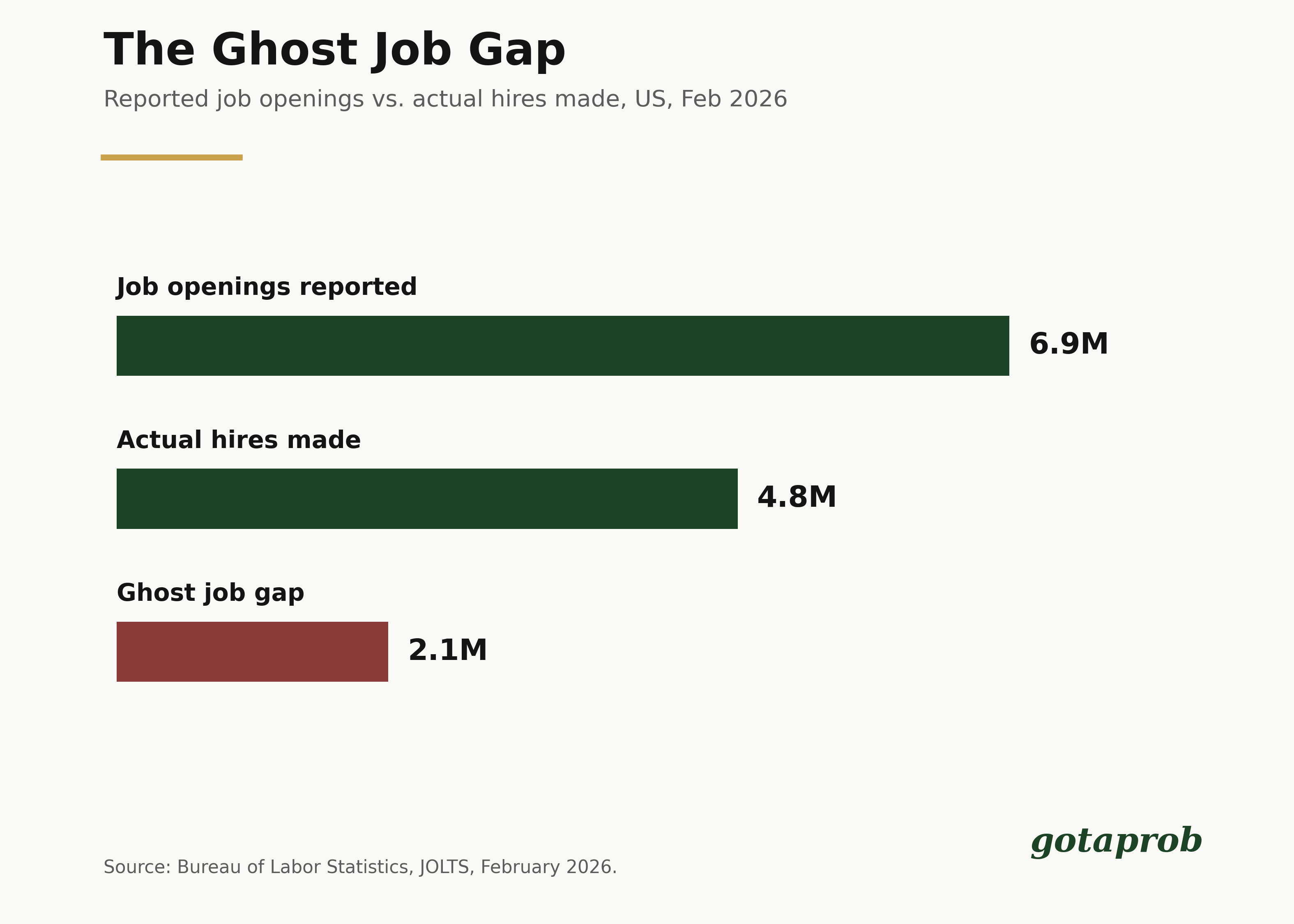
These are called ghost jobs. The BLS JOLTS data makes the scale visible: in February 2026, US employers reported 6.9 million job openings but made only 4.8 million actual hires. The 2.1 million gap between openings and hires represents positions that existed on job boards without any genuine near-term hiring activity behind them.
The five reasons companies do it
According to Clarify Capital's February 2026 analysis of 176,268 active Indeed listings across 49 industries, companies maintain ghost listings for five documented reasons:
- Pipeline building: accumulating resumes for roles they anticipate needing in three to six months, cited by 50% of hiring managers as the primary reason
- Market signalling: projecting growth and momentum to investors, competitors, and the market without committing to actual headcount
- Approved but unbudgeted roles: positions that received organisational sign-off in principle but have no confirmed budget to fill them
- Always open posture: maintaining permanent listings for high-turnover roles even when no current vacancy exists
- Compliance requirements: government and public sector roles legally required to be posted externally before an internal promotion or transfer can be finalised, accounting for an estimated 60% ghost job rate in government listings
Stay curious
One problem,
every Tuesday.
The most interesting problem of the week, straight to your inbox.
No spam. Unsubscribe anytime.
What it costs job seekers
53% of job seekers were ghosted by an employer in the past year according to iHire's 2026 Candidate Experience Survey, reported by Fortune in March 2026, a three-year high climbing from 38% in 2024 to 48% in 2025 to 53% in 2026. Listings widely flagged as ghost jobs commonly stay active for 30 to 45 days or more without an update, well past the point a genuinely open role would typically be filled. A job seeker who applies, tailors a cover letter, and follows up twice has invested real time in an interaction with no one on the other side.
Ontario became the first jurisdiction to make ghost jobs explicitly illegal in January 2026, requiring employers with 25 or more employees to disclose whether a posting is for a genuine existing vacancy and to notify every interviewed candidate within 45 days. Fines reach CAD $100,000 for violations. No equivalent law exists at the US federal level.
For the full breakdown of the ghost job problem, the BLS data, the employer-side admissions, and why job boards are not incentivised to fix it, read the complete gotaprob analysis: Four in Ten Companies Post Job Listings With No Real Intention of Hiring Anyone.
Sources
- LiveCareer, via Outsource Accelerator — Ghost Jobs Survey, 900+ HR professionals on reasons for posting without hiring intent, June 2025 — https://news.outsourceaccelerator.com/ghost-job-listings-livecareer/
- Clarify Capital — Ghost Jobs 2026, analysis of 176,268 active Indeed listings across 49 industries — https://clarifycapital.com/ghost-jobs-2026
- iHire 2026 Candidate Experience Survey, via InstantInterview — Employer ghosting statistics, 53% ghosted in 2026 up from 38% in 2024 — https://instantinterview.app/blog/interview-ghosting-statistics-2026
Go deeper
Four in ten companies post job listings with no real intention of hiring anyone