What Percentage of Mobile Game Ads Are Misleading?
Over 30% of mobile game playable ads misrepresent actual gameplay. In casual games the figure rises to 35%. Here's what the research shows and why it keeps happening.
According to Segwise's 2025 mobile advertising analysis, over 30% of all mobile game playable ads misrepresent the actual gameplay experience. In casual games specifically, the figure rises to 35% of playable ads using mechanics that do not reflect the real game.
That means roughly one in three mobile game ads you see is showing you a game that doesn't exist in the way it's being presented.
What counts as a misleading mobile game ad?
Penn State researchers studying fake mobile game ads in January 2025 identified five specific patterns:
Gameplay disguise: the ad shows mechanics that don't exist in the actual game. The classic example is the pin-pulling puzzle shown in Homescapes ads, when the actual game is a match-3 tile swapper.
Narrative pretense: the ad constructs an emotional storyline, usually involving a character in danger, that has no connection to the real game's content.
Popular externalization: the ad borrows visual elements from more famous games to create false familiarity.
Ruleset distortion: the rules shown in the ad don't apply to actual gameplay at all.
Incentive illusion: rewards shown in the ad either don't exist in the game or work completely differently.
Stay curious
One problem,
every Tuesday.
The most interesting problem of the week, straight to your inbox.
No spam. Unsubscribe anytime.
Why do studios keep running misleading ads if they know they're misleading?
Because they work, at least for installs. A medieval survival game called Kingshot ran fake ads using reskinned footage from Age of Empires and Kingdom Rush, none of it showing actual Kingshot gameplay, and earned 10 million downloads and $35 million in revenue in three months in 2025.
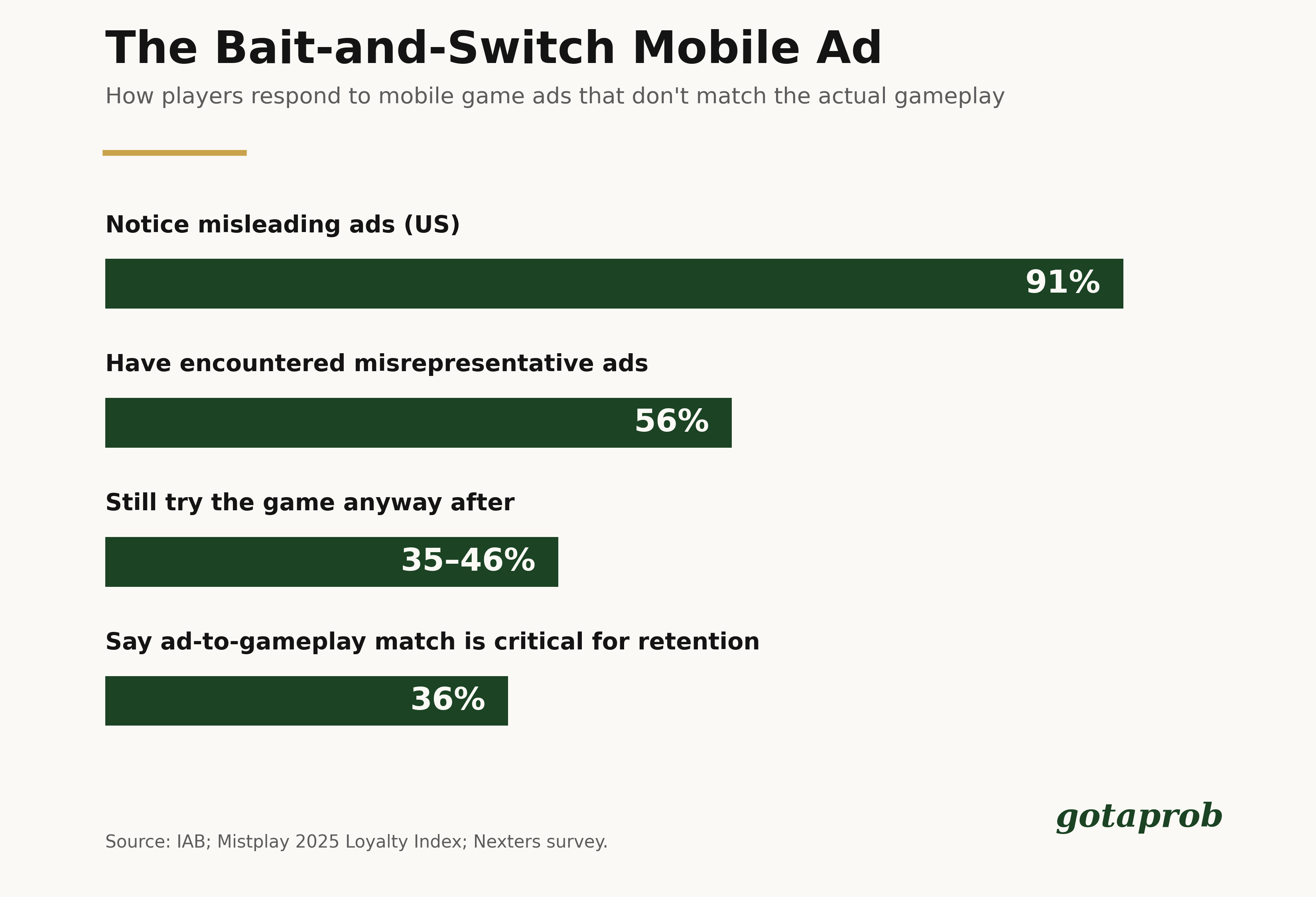
Mistplay's 2025 Mobile Gaming Loyalty Index found that 91% of US players notice when an ad is misleading, and yet 35 to 46% of players still give the game a chance after downloading it even when it doesn't match the ad. The install economics work even with high churn because the cost per install is low enough that studios profit before players uninstall.
Is anything being done about it?
Enforcement has increased but hasn't solved the problem.
Google updated its Play Store ad guidelines in August 2022, explicitly banning ads that don't accurately reflect the actual app. Apple has similar policies. Both platforms enforce reactively, after complaints, rather than proactively.
The UK's Advertising Standards Authority upheld a complaint against Top Games in 2024 over Evony: The King's Return ads that didn't reflect core gameplay. In April 2026, a New York federal jury awarded $420 million in damages to Skillz Platform against Papaya Gaming for false advertising, one of the largest judgments in mobile gaming history.
Regulatory pressure is real but slow. A studio can run misleading ads, generate significant revenue, and absorb the eventual enforcement cost as a line item against installs generated.
The player impact
The Nexters survey of 5,212 players found that 75% of users in Europe and the US say misleading ads look more fun than the actual games they advertise, which is exactly why studios run them. The promise works. The delivery doesn't. And the gap between the two is where player trust in mobile game advertising has collapsed.
For the full breakdown of how this works structurally, why regulators haven't fixed it, and what a solution would require, read the complete gotaprob analysis: Mobile game ads show completely different gameplay from the actual game.
Sources
- Segwise — Fake Ads and Mobile Gaming 2025 analysis — https://segwise.ai/blog/fake-ads-and-mobile-gaming-how-studios-balance-clickbait-gameplay-integrity-and-profitability-cm7j2hc9s00bvip0l0r4k59lw
- TechXplore — Penn State research on five characteristics of fake mobile game ads January 2025 — https://techxplore.com/news/2025-01-ways-fake-mobile-games-advertised.html
- Mistplay — False advertising in mobile games 2026 — https://business.mistplay.com/resources/false-advertising-in-mobile-games
- Z2A Digital — Fake mobile game ads risks and examples 2026 — https://www.z2adigital.com/blog-content/fake-mobile-game-ads
- Nexters misleading ads survey 2023 — https://gamedevreports.substack.com/p/nexters-misleading-ads-survey-2023
Go deeper
Mobile game ads show completely different gameplay from the actual game and regulators have barely touched it