Why Is It So Hard to Cancel a Subscription?
It is hard by design. Companies use documented dark patterns to make cancellation deliberately difficult, and a federal click-to-cancel rule was struck down in 2025.
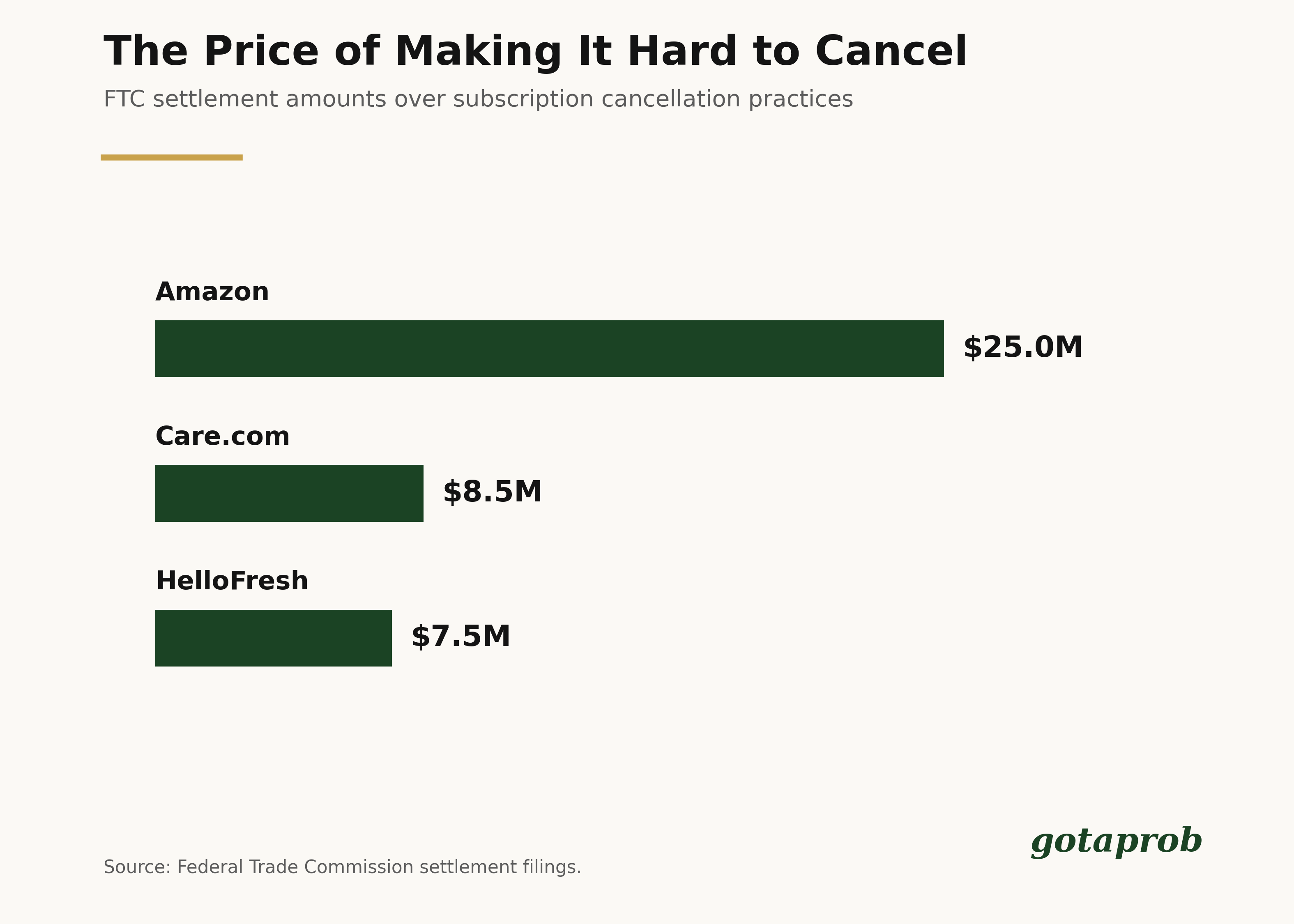
Subscription cancellation is deliberately difficult. This is not an accident of poor design. It is a documented business strategy with a name, a legal definition, and a long record of enforcement by the Federal Trade Commission.
The specific tactics that make it hard
The FTC and consumer researchers have documented the exact mechanics companies use. These are called dark patterns, design choices that steer users toward outcomes they did not intend:
- Hidden cancellation paths: the cancel option buried in nested menus, available only through a specific sequence of clicks that is never advertised
- Mandatory phone calls: requiring customers to call a number during business hours to cancel a subscription that took thirty seconds to start online
- Endless retention flows: presenting multiple offers, discounts, and pauses before reaching an actual cancellation option, each step designed to create friction or change the customer's mind
- Confirmation shaming: cancel buttons labelled "No thanks, I don't want to save money" rather than a neutral confirmation
- Automatic renewal without clear notice: subscriptions that renew automatically with insufficient advance notice, discovered only when a charge appears
70% of consumers have forgotten to cancel a free trial at some point, locking them into a paid subscription, and the average person wastes $26.79 per month on subscriptions they don't actively use, more than double the $10.57 figure from the year before, according to Self Financial's 2026 survey of 1,272 US adults.
Stay curious
One problem,
every Tuesday.
The most interesting problem of the week, straight to your inbox.
No spam. Unsubscribe anytime.
The federal rule that was struck down
The FTC finalised its Click to Cancel rule in October 2024. It would have required cancellation to be at least as easy as sign-up. On July 8, 2025, the US Court of Appeals for the Eighth Circuit vacated the entire rule, finding that the FTC had not followed the required procedures. There is no federal click-to-cancel requirement in force today. The FTC restarted the rulemaking process in March 2026, according to Cooley's analysis of the decision.
The FTC can still act against unfair or deceptive subscription practices under existing law, and it has.
Enforcement continues anyway
The most significant case is Amazon's Prime cancellation flow, which employees reportedly called "the Iliad Flow" internally. Amazon settled with the FTC in September 2025 for $2.5 billion, $1 billion in penalties and $1.5 billion in consumer refunds, over claims that it used dark patterns to enrol and keep consumers in Prime subscriptions they did not want. The same tactics, hidden menus, multi-step retention flows, and phone-only cancellation, turn up across unrelated companies, which is why they look deliberate rather than accidental.
For the full breakdown of how subscription dark patterns work structurally and why existing tools fail to protect consumers, read the complete gotaprob analysis: You're Paying for Subscriptions You Forgot About and Companies Make It Deliberately Impossible to Cancel.
Sources
- Cooley — Click to Cancel Just Got Cancelled: Eighth Circuit Vacates Entirety of FTC's Negative Option Rule, July 2025 — https://www.cooley.com/news/insight/2025/2025-07-11-click-to-cancel-just-got-cancelled-eighth-circuit-vacates-entirety-of-ftcs-negative-option-rule
- Self Financial — Cost of Unused Paid Subscriptions 2026, survey of 1,272 US adults — https://www.self.inc/info/cost-of-unused-paid-subscriptions/
Go deeper
You're paying for subscriptions you forgot about and companies make it deliberately impossible to cancel