Why Are Crypto Taxes So Complicated?
The IRS treats crypto as property, not currency. Every trade, swap, and purchase is a taxable event. Only 32% to 56% of US crypto holders report transactions correctly. Here is why it is so hard.
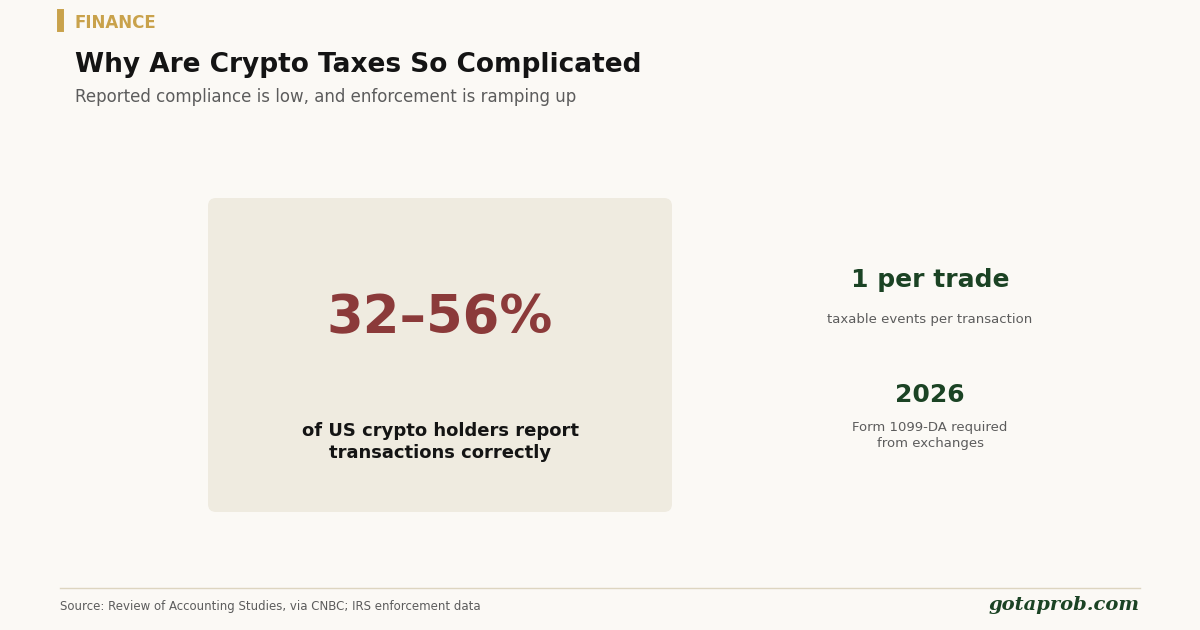
Crypto taxes are complicated because the IRS treats cryptocurrency as property rather than currency, which means every disposal, every trade, swap, sale, or purchase of goods with crypto, triggers a taxable capital gain or loss that must be individually reported. Determining tax on digital asset transactions is notoriously difficult, often much more so than for traditional financial assets like stocks and bonds, according to CNBC's August 2026 reporting on IRS enforcement of crypto tax rules.
By one estimate, only 32% to 56% of US taxpayers with crypto holdings report their transactions to the federal government correctly, according to a research paper published in March 2026 in the Review of Accounting Studies cited by CNBC.
The specific reasons it is harder than stocks
Every transaction is a taxable event. When you sell a stock, you have one taxable event. When you hold crypto, every trade between cryptocurrencies, every use of crypto to pay for goods or services, every swap on a decentralised exchange, and every sale generates a separate taxable event requiring you to calculate the gain or loss from that specific transaction. An active trader can generate hundreds or thousands of taxable events in a single year.
Cost basis is hard to track. To calculate a gain or loss, you need to know what you originally paid for each unit of crypto (the cost basis) and what you received when you disposed of it. If you bought Bitcoin in multiple purchases over multiple years and then sold a portion, calculating which units you sold and at what cost requires either meticulous record-keeping or specialised software.
Exchanges did not historically issue consistent tax forms. Until 2026, crypto exchanges issued inconsistent or incomplete tax reporting. Some sent 1099-MISC for income but not capital gains. Some sent nothing at all. Form 1099-DA, the new standardised form for crypto disposals, was introduced for 2025 transactions, meaning exchanges are now required to report gross proceeds to the IRS for the first time, according to Koinly's 2026 tax guide.
The 1099-DA has a known problem for 2025 returns. Even with the new form, 2025 returns face a specific challenge: brokers are only required to report gross proceeds for 2025 transactions, not cost basis. Many 1099-DA forms will show large sale numbers without any cost basis information. If you do not provide your own cost basis documentation, the IRS may treat basis as zero, meaning you could appear to owe tax on the entire sale amount rather than just the gain, according to TaxPlanIQ's 2026 digital asset update.
Stay curious
One problem,
every Tuesday.
The most interesting problem of the week, straight to your inbox.
No spam. Unsubscribe anytime.
What changed in 2026
Form 1099-DA is now required from all centralised crypto exchanges for 2025 transactions. The IRS receives a copy of every form, meaning it can now match reported proceeds against a taxpayer's return the same way it does for stock sales. Crypto holders whose returns do not reconcile with their 1099-DA data face CP2000 notices and potential audit exposure.
IRS enforcement is increasing. The IRS pulled in over 600,000 John Doe summons records from exchanges in 2024, according to taxpayers.net's August 2026 analysis. The agency has been issuing warning letters to investors it believes are underreporting throughout 2025 and 2026.
What makes it easier
Crypto tax software, Koinly, CoinTracker, TaxBit, imports transaction histories from exchanges and wallets, calculates gains and losses using the correct cost basis method, and generates the forms needed for tax filing. These tools do not eliminate the complexity but they reduce the manual calculation required significantly.
For the full breakdown, read the complete gotaprob analysis: Crypto Taxes Across Multiple Wallets and Exchanges Are Nearly Impossible to Calculate Without Paying an Accountant Who Also Does Not Fully Understand Them.
Sources
- CNBC — IRS Form 1099-DA crypto tax reporting rules, August 2026, 32-56% compliance rate from Review of Accounting Studies — https://www.cnbc.com/2026/08/05/irs-form-1099-da-crypto-tax-reporting-rules.html
- Koinly — Crypto Taxes Complete Guide 2026, 1099-DA requirements and exchange reporting obligations — https://koinly.io/guides/crypto-taxes/
- TaxPlanIQ — Crypto Tax and Digital Asset Updates 2026, cost basis reporting gap and 1099-DA reconciliation risk — https://www.taxplaniq.com/blog/crypto-tax-and-digital-asset-updates-what-you-need-to-know-in-2025
Go deeper
Crypto taxes across multiple wallets and exchanges are nearly impossible to calculate without paying an accountant who also does not fully understand them