What Percentage of People Actually Stick With a Budget?
Only 32% of Americans maintain a household budget. Of those who try budgeting apps, most abandon them within the first month. Here is what the research shows about why budgets fail.
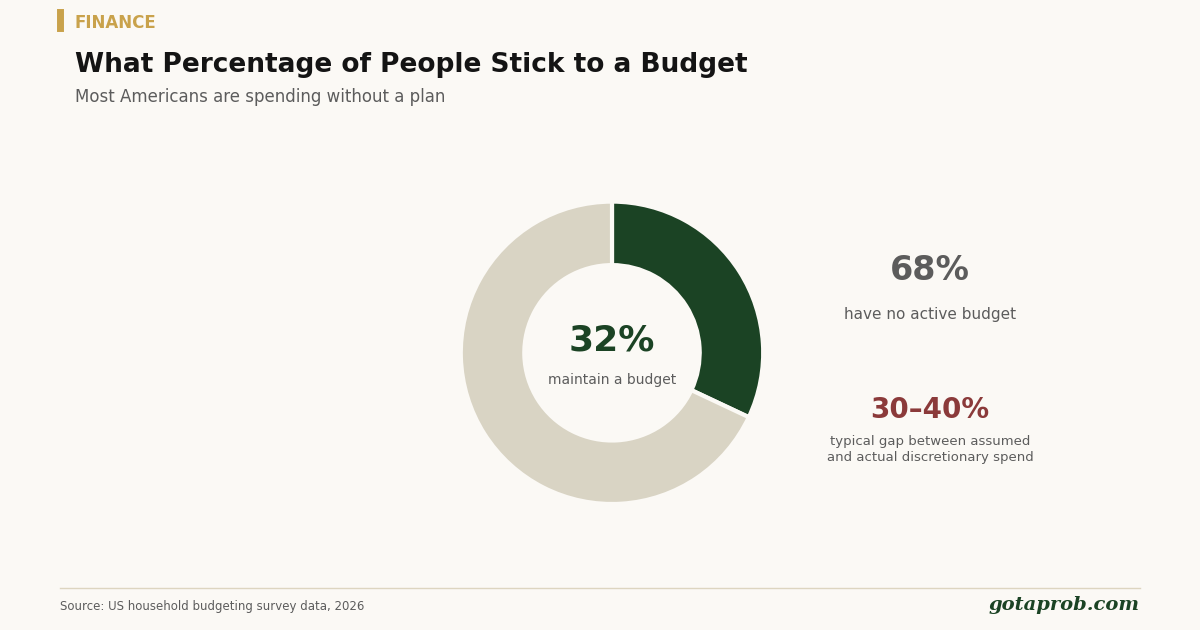
Only 32% of Americans maintain a household budget, according to Gallup's household budget survey, meaning roughly two in three Americans have no active budget at all. Of those who do attempt to budget using an app, retention drops off fast: Day-30 retention for personal finance apps averages just 38%, and the top apps in the category still lose 71% of daily active users between Day 1 and Day 30, according to Strategia-X's 2026 analysis of Apptopia and Sensor Tower retention data.
Why most budgets fail within 30 days
Research on budgeting behaviour consistently identifies the same failure patterns:
Too much manual input. Most budgeting apps require users to categorise transactions, correct miscategorised expenses, and manually add cash spending. Manual entry is the single biggest driver of abandonment, producing churn roughly three times higher than apps built around automatic bank syncing, which is consistently the highest-leverage retention feature across the category.
Unrealistic starting assumptions. Most budgets are built on what people think they spend rather than what they actually spend. 89% of consumers underestimate their own subscription spending specifically, and 66% underestimate it by more than $200, according to Self Financial's 2026 survey of 1,272 US adults. The same gap between assumed and actual spending shows up across other discretionary categories like dining and entertainment.
The all-or-nothing response to failure. One missed category entry or one over-budget week causes many people to abandon the budget entirely rather than adjust it. Behavioural economists call this the what-the-hell effect, once a self-imposed rule is broken, the motivation to follow it collapses.
Budgets built for discipline rather than behaviour. Traditional budgets assume that tracking spending changes spending. Research published in the Journal of Consumer Research found that budgeting increases awareness but does not reliably change the underlying habits that drive overspending.
Stay curious
One problem,
every Tuesday.
The most interesting problem of the week, straight to your inbox.
No spam. Unsubscribe anytime.
What actually works
The budgets with the highest sustained adherence share one characteristic: they reduce decisions rather than adding them. The 50/30/20 rule (50% needs, 30% wants, 20% savings) works better than granular category budgets because it requires fewer weekly decisions. Automatic transfers to savings on payday work better than manual saving because the decision is made once rather than repeatedly.
Consumer Financial Protection Bureau research analysing a personal finance app's users found that "guaranteed" saving rules, like automatically saving a fixed amount every payday, produced 1.5 to 3.5 times larger increases in savings than rules contingent on spending activity, like rounding up each purchase. The automation removes the point of friction where most budgets break down.
The app abandonment rate
Specific app-level retention data is not publicly disclosed by most budgeting app companies. Mint, which was the most widely used free budgeting app in the US, was shut down by Intuit in January 2024. Its closure left millions of users without a tool and contributed to what personal finance researchers describe as a gap in the accessible budgeting tool market for users who cannot afford premium subscriptions.
YNAB, which charges $14.99 per month or $99 per year, reports significantly higher engagement and retention than free alternatives, partly because paying for a tool creates commitment that free tools do not. The willingness-to-pay filters for the users most likely to engage seriously with the process.
For the full breakdown, read the complete gotaprob analysis: Budgeting Apps Are Complicated Enough That Most People Abandon Them Within a Week of Downloading.
Sources
- Gallup — Do You Have a Household Budget, percentage of Americans who maintain a budget — https://news.gallup.com/poll/162872/americans-budget.aspx
- Strategia-X — 2026 analysis of Apptopia and Sensor Tower budgeting app retention data — https://www.strategia-x.com/blog/2026-04-12-why-budgeting-apps-fail-30-days-fintech-ux-data/
- Self Financial — 2026 survey on unused and forgotten subscription costs, 1,272 US adults — https://www.self.inc/info/cost-of-unused-paid-subscriptions/
- Consumer Financial Protection Bureau — Consumer Savings App Strategies and Savings Outcomes, Office of Research Staff Report 2022-01 — https://www.consumerfinance.gov/data-research/research-reports/consumer-savings-app-strategies-and-savings-outcomes/
Go deeper
Budgeting apps are complicated enough that most people abandon them within a week of downloading