What Percentage of Online Reviews Are Fake?
Between 30% and 40% of online reviews are estimated to be fake or incentivized in 2026. On major websites up to 43% are identified as suspicious. Platforms remove an average of 6.9%.
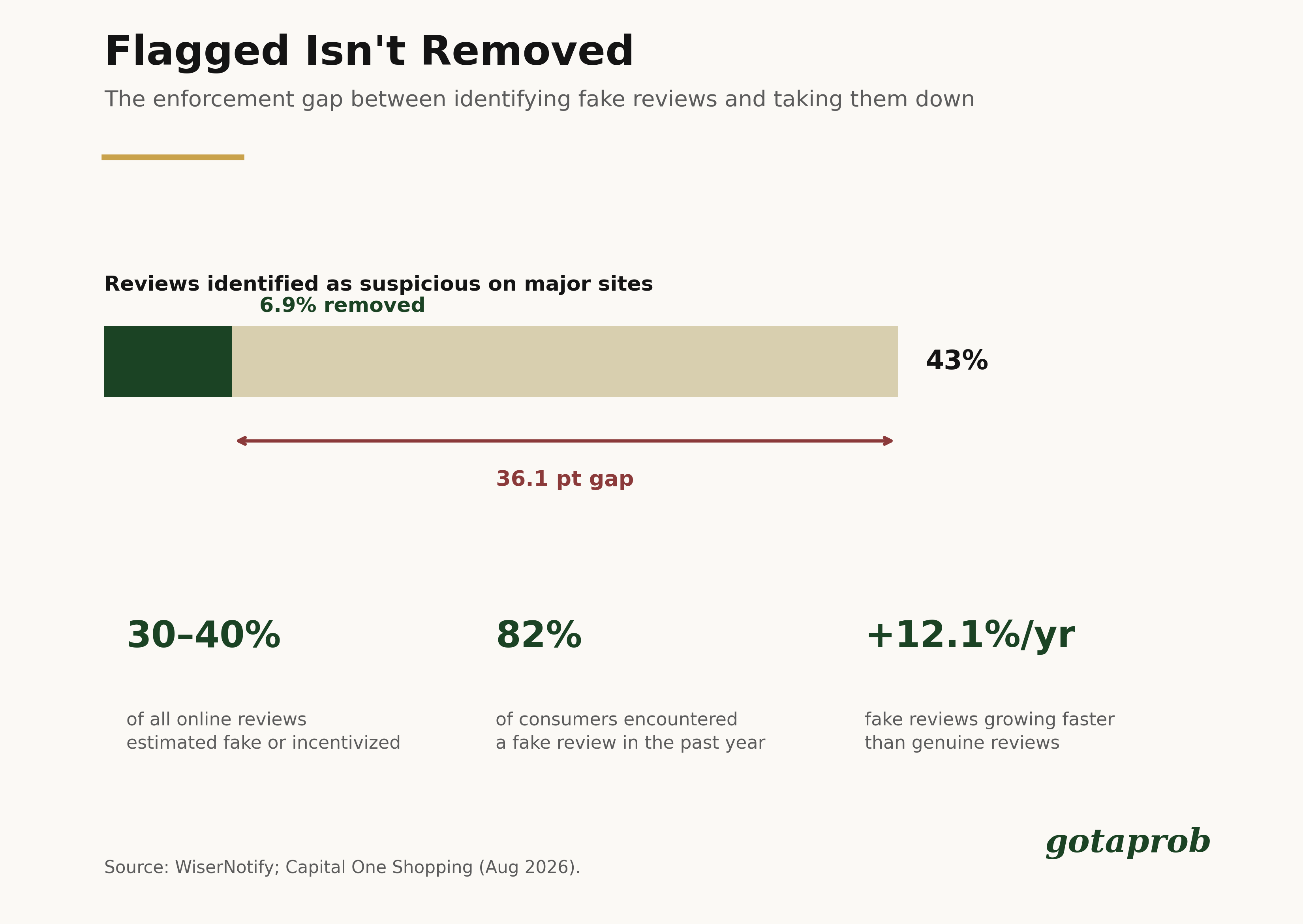
Between 30% and 40% of online reviews are estimated to be fake or incentivized in 2026, according to WiserNotify's August 2026 analysis of the latest platform enforcement data. On major websites, up to 43% of reviews are identified as suspicious. Platforms remove an average of 6.9% of those reviews. The rest stay up.
That gap, between identified and removed, is the core of the problem.
How the numbers break down by platform
The fake review rate is not evenly distributed. According to Nadernejad Media's April 2026 analysis:
- Google has the highest fake review rate at 10.7%
- Yelp follows at 7.1%
- TripAdvisor at 5.2%
- Facebook at 4.9%
Amazon tells a different story. In a single year, Amazon spent over $500 million and employed 8,000 people specifically to fight fake reviews, removing over 275 million in 2024 alone, according to Capital One Shopping's 2026 research. Despite that, 43% of Amazon reviews were still identified as fake or inauthentic.
Enforcement at scale is not solving the problem. It is managing it.
Stay curious
One problem,
every Tuesday.
The most interesting problem of the week, straight to your inbox.
No spam. Unsubscribe anytime.
Why platforms remove so few of the reviews they flag
The economic incentive runs in the wrong direction. Higher star ratings produce higher conversion rates. A product moved from a 3.8 to a 4.5 star average sees a measurable increase in sales. That increase benefits the platform through higher gross merchandise value and advertising spend from sellers who want to protect their position.
Removing suspicious reviews aggressively would lower ratings on high-revenue products. Platforms flag them and leave them up instead. RetainTrust's May 2026 independent research found that only 53% of online reviews are fully trustworthy, meaning nearly half of what consumers read before making purchasing decisions is either fake, poorly written, or impossible to verify.
What consumers know and do about it
74% of consumers admit they cannot always tell whether a review is genuine or fake, according to WiserNotify. 82% have encountered a fake review in the past year. 85% suspect reviews are fake sometimes or often.
Awareness has not produced a fix. What it has produced is a set of informal consumer heuristics: looking for review spikes, preferring 3 to 4 star products over 5 star ones, checking the distribution rather than the average. These workarounds work for experienced shoppers and fail for everyone else.
88% of shoppers are against AI-generated reviews specifically, according to Ringly.io's July 2026 data. The irony is that AI-generated fake reviews are growing faster than any detection tool can keep pace with: the number of fake reviews is growing 12.1% faster than the total number of genuine reviews every year.
For the full breakdown of why the star rating system is structurally broken and why AI shopping agents are being positioned as the replacement into an equally broken trust environment, read the complete gotaprob analysis: Star Ratings Are Broken and the AI Shopping Agents Replacing Them Are Not Trusted Either.
Sources
- WiserNotify — 22 Fake Review Statistics for 2026, August 2026 platform enforcement data — https://wisernotify.com/blog/fake-review-stats/
- Capital One Shopping — Fake Review Statistics 2026, Amazon enforcement spending and removal numbers — https://capitaloneshopping.com/research/fake-review-statistics/
- Nadernejad Media — Fake Review Statistics 2026, platform breakdown by Google, Yelp, TripAdvisor, Facebook — https://nadernejadmedia.com/fake-review-statistics-the-scale-of-the-problem-in-2026/
- RetainTrust — Fake Reviews Statistics May 2026, independent research on review authenticity — https://retaintrust.com/fake-reviews-statistics/
- Ringly.io — 59 Online Review Statistics 2026, AI-generated review attitudes and growth rate — https://www.ringly.io/blog/online-review-statistics-2026
Go deeper
Star Ratings Are Broken and the AI Shopping Agents Replacing Them Are Not Trusted Either