What Is Tip Fatigue?
Tip fatigue is the consumer frustration caused by being asked to tip in situations where tipping was previously uncommon. 41% of Americans say tipping is out of control, up from 35% a year earlier. Here is what the research shows.
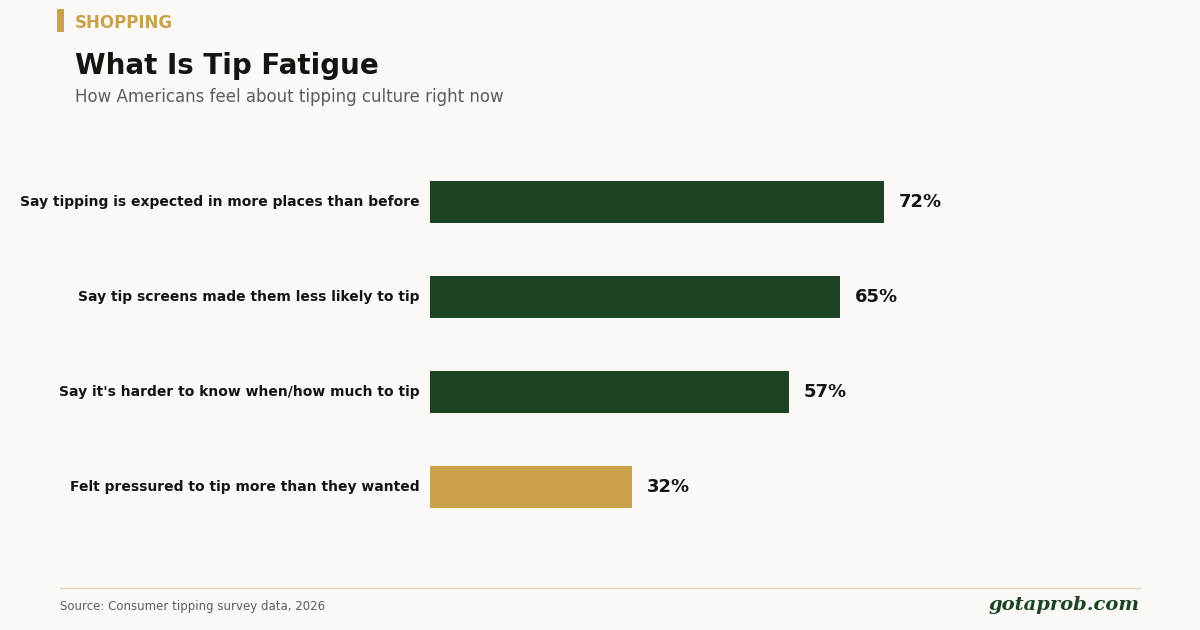
Tip fatigue is the growing consumer frustration caused by being asked to tip in an expanding range of situations where tipping was not previously expected. The term describes the emotional and financial exhaustion of encountering tip prompts at coffee shops, fast food counters, self-checkout kiosks, and other contexts where the transaction historically involved no gratuity.
41% of Americans say tipping culture has gotten out of control, up from 35% the year before, according to Bankrate's 2025 survey of 2,445 US adults. 63% hold at least one negative view about tipping overall, and 38% specifically say they feel annoyed by pre-entered tip screens at checkout, suggesting the frustration is concentrated on how tipping is being asked for, not just how often.
Where it came from
The spread of tip prompts accelerated sharply after 2020 for two documented reasons.
First, point-of-sale systems shifted from cash registers to tablet-based payment terminals during the pandemic as businesses sought contactless transactions. These systems, built by companies like Square and Toast, default to displaying tip screens as part of the payment flow. The default tip options, typically 18%, 20%, and 25%, appear before the customer can complete the transaction regardless of the service context.
Second, many service businesses raised prices without fully restoring pre-pandemic wages, creating pressure on workers who relied on tips while simultaneously expanding the range of businesses using tip-prompt technology. The result was tip requests appearing in contexts, counter service, self-checkout, digital orders, where no tipping norm had previously existed.
Stay curious
One problem,
every Tuesday.
The most interesting problem of the week, straight to your inbox.
No spam. Unsubscribe anytime.
The psychology behind the discomfort
The tip screen turned to face the customer is specifically designed to create social pressure at the point of payment. Research on what behavioural economists call the observer effect confirms that people tip more when they believe they are being watched. A screen turned toward the customer while the worker stands nearby is a deliberate application of this pressure.
14% of Americans say they are outright confused about who and how much to tip, up from 11% the year before, according to Bankrate's same 2025 survey. Only around a third say it is extremely or very easy to know whether or how much to tip for a given service. The confusion itself is a documented, growing outcome, the proliferation of tip prompts has created genuine uncertainty about social norms in contexts where those norms did not previously exist.
What consumers are doing about it
27% of Americans say they tip less or not at all specifically when presented with a pre-entered tip screen, according to the same Bankrate survey, and 41% say businesses should pay their employees better rather than relying so much on tips.
The counterintuitive finding is that tip fatigue may be reducing tipping at traditional full-service restaurants alongside reducing tipping at non-traditional venues. When tipping feels obligatory everywhere, it loses the social meaning that made it a meaningful signal of appreciation in contexts where it genuinely applied.
For the full breakdown, read the complete gotaprob analysis: Nobody Knows When They Are Supposed to Tip Anymore and the iPad Turning to Face You Was Designed to Exploit That Confusion.
Sources
- Bankrate — Tipping Culture Survey 2025, survey of 2,445 US adults on tipping norms and attitudes — https://www.bankrate.com/credit-cards/news/tipping-culture-survey/
Go deeper
Nobody knows when they are supposed to tip anymore and the iPad turning to face you was designed to exploit that confusion