Is It Illegal to Record Someone With Meta Glasses?
Recording video in public with Meta Ray-Ban glasses is generally legal in the US. The audio is where it gets complicated, and the law varies by state.
Recording someone in public with Meta Ray-Ban smart glasses is generally legal in the United States. The video is rarely the legal problem. The audio is, and where you are determines whether capturing a private conversation without consent is a civil matter, a crime, or somewhere in between, according to Recording Law's comprehensive 2026 state-by-state guide.
The split most people miss
Meta glasses record two things simultaneously: video and audio. The law treats them very differently.
Video in a public place is almost always legal. People in public spaces have no reasonable expectation of privacy. Filming what you can see from a public street, a park, or a store is generally permitted regardless of the device used.
Audio of a private conversation is governed by wiretap law. This is where state consent rules apply:
- One-party consent states (roughly 38 states): Only one person in the conversation needs to consent to the recording. If you are wearing the glasses and part of the conversation, you are the consenting party. Legal.
- All-party consent states (including California, Florida, Illinois, Washington): Everyone in the conversation must consent. Recording a private conversation without that consent can be a crime even if you are standing in a public place.
The distinction matters more than most people realise. A person filming a street scene is in completely different legal territory than a person recording a private conversation at a coffee shop, even if both are wearing the same glasses.
Stay curious
One problem,
every Tuesday.
The most interesting problem of the week, straight to your inbox.
No spam. Unsubscribe anytime.
Where it gets more complicated
Recording is generally illegal in areas where people have a reasonable expectation of privacy regardless of consent rules, according to Purdue Global Law School's 2026 privacy analysis. Bathrooms, changing rooms, medical facilities, and private residences create a higher legal exposure even for video.
The Bartone v. Meta lawsuit, filed in March 2026, illustrates the residential dimension specifically. One documented case involved a man who left his glasses recording on a bedside table while his partner changed clothes, unaware the device was still active. That footage was later reviewed by human contractors at a Kenya-based Meta subcontractor. The lawsuit alleges the company's marketing, which promised the product was "designed for privacy, controlled by you," constituted false advertising given what actually happened to the footage, according to Fortune's March 2026 coverage of the case.
What is changing in 2026
The legal landscape is moving, but slowly and unevenly:
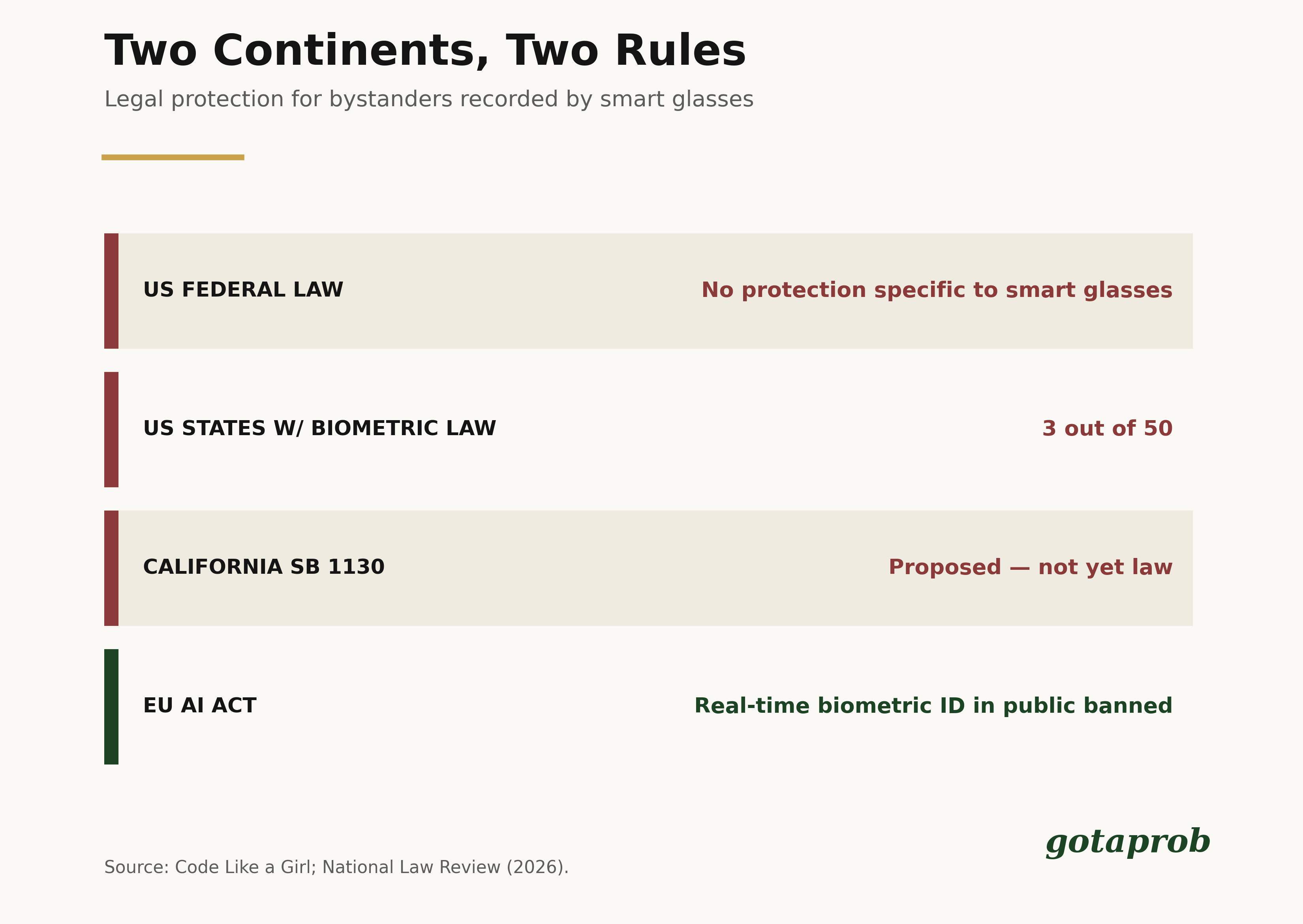
- California introduced Senate Bill 1130, the Wearable Device Privacy Protection Act, in February 2026. It would make it a crime to secretly record people using wearable devices inside places of business.
- Texas Attorney General Ken Paxton opened an investigation into Meta's smart glasses in 2026, issuing a civil investigative demand about how the company collects and uses consumer data, according to Law Commentary.
- ICE reaffirmed in August 2026 that its existing body-worn-camera ban covers personal Meta glasses, and a growing number of workplaces and institutions are formalising their own recording policies for devices that look like ordinary eyewear.
- EU AI Act already classifies real-time biometric identification in public spaces as high-risk, giving European bystanders significantly stronger protections than US residents currently have.
At the federal level, there is no comprehensive privacy law in the United States that specifically addresses wearable cameras. The American Data Privacy and Protection Act has stalled repeatedly in Congress. There is no federal equivalent to the EU's GDPR and no federal body with clear jurisdiction over what Meta's glasses collect from bystanders.
The practical reality for bystanders
If you discover you were filmed by someone wearing Meta glasses in a public space, your legal options in most US states are limited. Silent video in public is almost certainly legal. Audio captured in a one-party consent state is almost certainly legal. The only clear legal recourse in most states involves recordings made in spaces where you had a reasonable expectation of privacy.
The Code Like a Girl analysis published in May 2026 puts it plainly: only three US states have dedicated biometric privacy statutes with real enforcement teeth. Illinois's Biometric Information Privacy Act is the most consequential, requiring informed written consent before collecting biometric identifiers including face geometry. For everyone else, the law has not caught up to the device.
For the full breakdown of the privacy gap, the Bartone lawsuit, and why existing laws offer bystanders almost no protection, read the complete gotaprob analysis: People Are Being Secretly Recorded by Strangers Wearing Meta Smart Glasses in Public and There Is Currently No Law That Gives Them Any Recourse.
Sources
- Recording Law — Smart Glasses Recording Laws by State 2026, one-party vs all-party consent breakdown — https://www.recordinglaw.com/smart-glasses-recording-laws/
- Purdue Global Law School — Smart Glasses and Privacy Risks 2026, reasonable expectation of privacy analysis — https://www.purduegloballawschool.edu/blog/news/smart-glasses-privacy-risks
- Law Commentary — Meta AI Smart Glasses Raise Privacy Questions, Texas AG investigation and woman filmed without consent — https://www.lawcommentary.com/articles/meta-ai-smart-glasses-raise-privacy-questions-after-woman-says-she-was-secretly-recorded
- Fortune — Meta Smart Glasses Filming Workers Lawsuit Privacy, Bartone v Meta case details — https://fortune.com/2026/03/27/meta-smart-glasses-filming-watching-workers-lawsuit-privacy/
- Code Like a Girl — Meta Smart Glasses Record Inside Your Home, state biometric privacy law analysis — https://codelikeagirl.substack.com/p/meta-smart-glasses-privacy-recording-bystanders-law
Go deeper
People are being secretly recorded by strangers wearing Meta smart glasses in public and there is currently no law that gives them any recourse