How Much Money Do Sports Bettors Lose Per Year?
The average US sports bettor lost $430 in 2025. Sportsbooks kept 9.74 cents of every dollar wagered, generating $16.1 billion in gross revenue from $165 billion in bets.
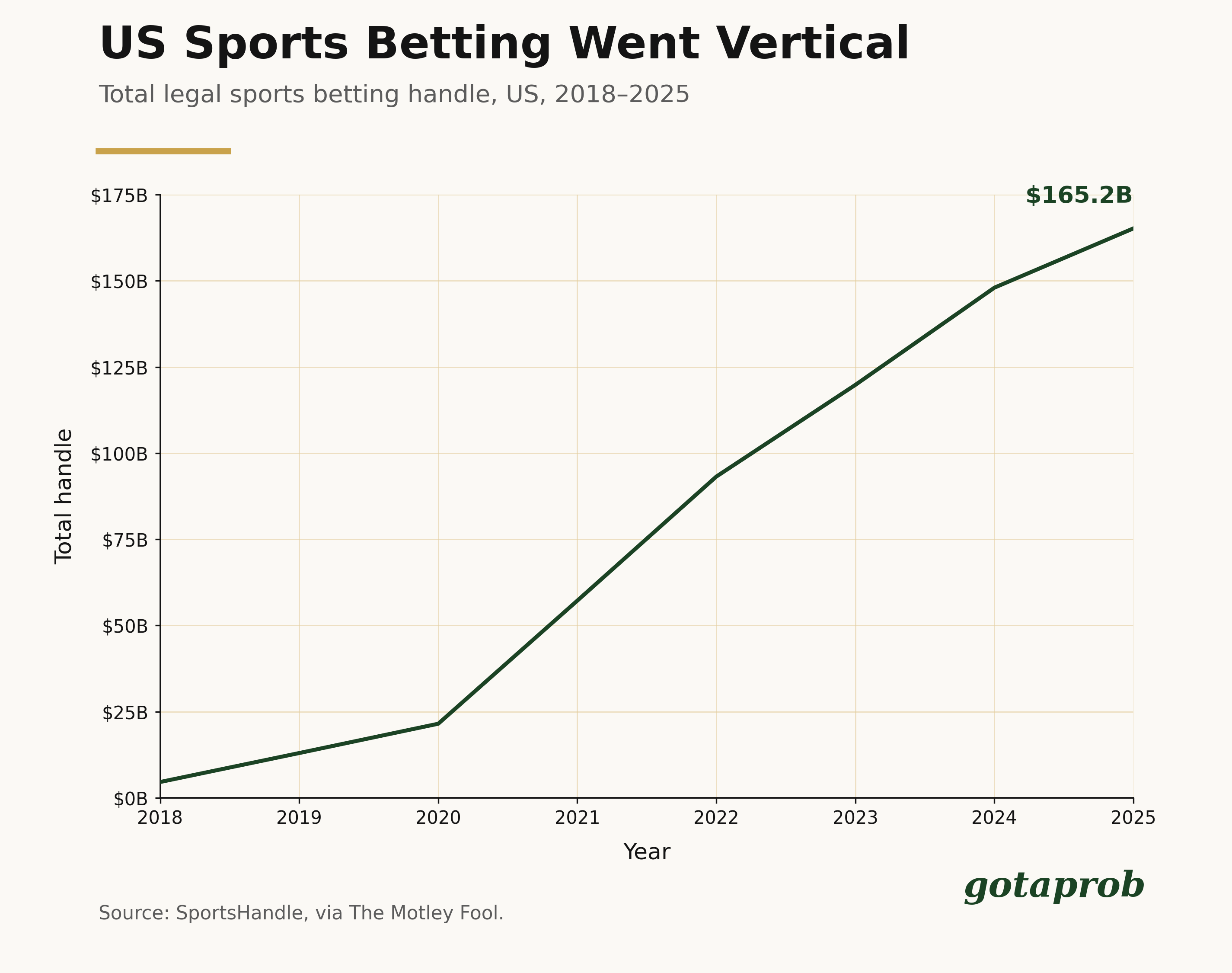
The average US sports bettor lost $430 in 2025, according to Motley Fool's May 2026 analysis of SportsHandle.com data. Americans wagered $165.2 billion on sports that year. Sportsbooks kept 9.74 cents of every dollar wagered, generating $16.1 billion in gross revenue. The sportsbooks have posted a record annual handle every year since federal legalisation in 2018.
How the math works against bettors
Sportsbooks set their odds to ensure they retain a percentage of every dollar wagered regardless of outcomes. This built-in margin is called the vig or juice. At a 9.74% retention rate, a bettor who wagers $1,000 over the course of a season is expected to receive back approximately $902. The $98 difference is not lost due to bad luck. It is the mathematical cost of participating.
This is structurally different from investing. A diversified index fund has returned positive real gains across every 30-year period in US market history. The expected value of a sports bet, calculated across a large enough number of bets, is always negative by design.
The $430 average annual loss figure understates what heavy bettors lose. The median bettor loses $430, but the distribution is wide. NerdWallet's 2025 Sports Betting survey found the average self-reported annual gambling spend was $3,284, with a median of $750. The gap between mean and median indicates a subset of heavy bettors pulling the average significantly higher.
Stay curious
One problem,
every Tuesday.
The most interesting problem of the week, straight to your inbox.
No spam. Unsubscribe anytime.
What bettors actually understand about the odds
31% of sports bettors view gambling as a form of investment, according to NerdWallet. This misclassification produces the most financially harmful behaviour: allocating money from a retirement or savings mental account to an activity with a guaranteed negative expected return, under the belief that skill or research can overcome the house edge consistently.
14% of sports bettors have gone into debt to gamble. 29% plan to increase their betting amount in 2026 compared to 2025.
The opportunity cost no app shows you
The $430 average annual loss has a second dimension that sportsbook apps never surface. Invested annually in a diversified index fund at a 7% historical average return, $430 per year grows to approximately $43,000 over 30 years. The average 30-year-old who bets $430 per year until retirement is not just losing $430, they are forgoing roughly $43,000 in compounding returns.
NBER Working Paper 33108, a peer-reviewed study across 230,000 households, found that $1 of sports betting reduces net financial investment by approximately $1. The effect is not discretionary spending replacing entertainment spending. It is savings and investment being displaced dollar for dollar.
The state of the market
Sports betting is now legal in 38 states and Washington DC. Americans wagered $4.6 billion in 2018, the year of federal legalisation. They wagered $165.2 billion in 2025, a 35-fold increase in seven years. The handle has set a record every year since legalisation. The average bettor's losses have grown alongside it.
For the full breakdown of how sports betting displaces retirement savings, the NBER household research, and why no betting app has ever shown a bettor their compounding opportunity cost, read the complete gotaprob analysis: Sports Betting Has Been Legalised Everywhere and the Research Shows Every Dollar Bet Is a Dollar Not Invested.
Sources
- Motley Fool — Sports Betting vs Investing May 2026, $430 average loss, $165.2 billion handle, 9.74% sportsbook retention — https://www.fool.com/research/sports-betting-vs-investing/
- NerdWallet — 2025 Sports Betting and Gambling Survey, 31% view as investment, debt statistics — https://www.nerdwallet.com/investing/studies/2025-sports-betting-and-gambling-survey
- NBER Working Paper 33108 — $1 betting reduces $1 investment, 230,000 household study — https://www.nber.org/papers/w33108
Go deeper
Sports Betting Has Been Legalised Everywhere and the Research Shows Every Dollar Bet Is a Dollar Not Invested