How Much Does It Cost to Have All Streaming Services in 2026?
Eight major US streaming services with no ads now cost about $140 per month combined. That is more than cable cost at its peak.
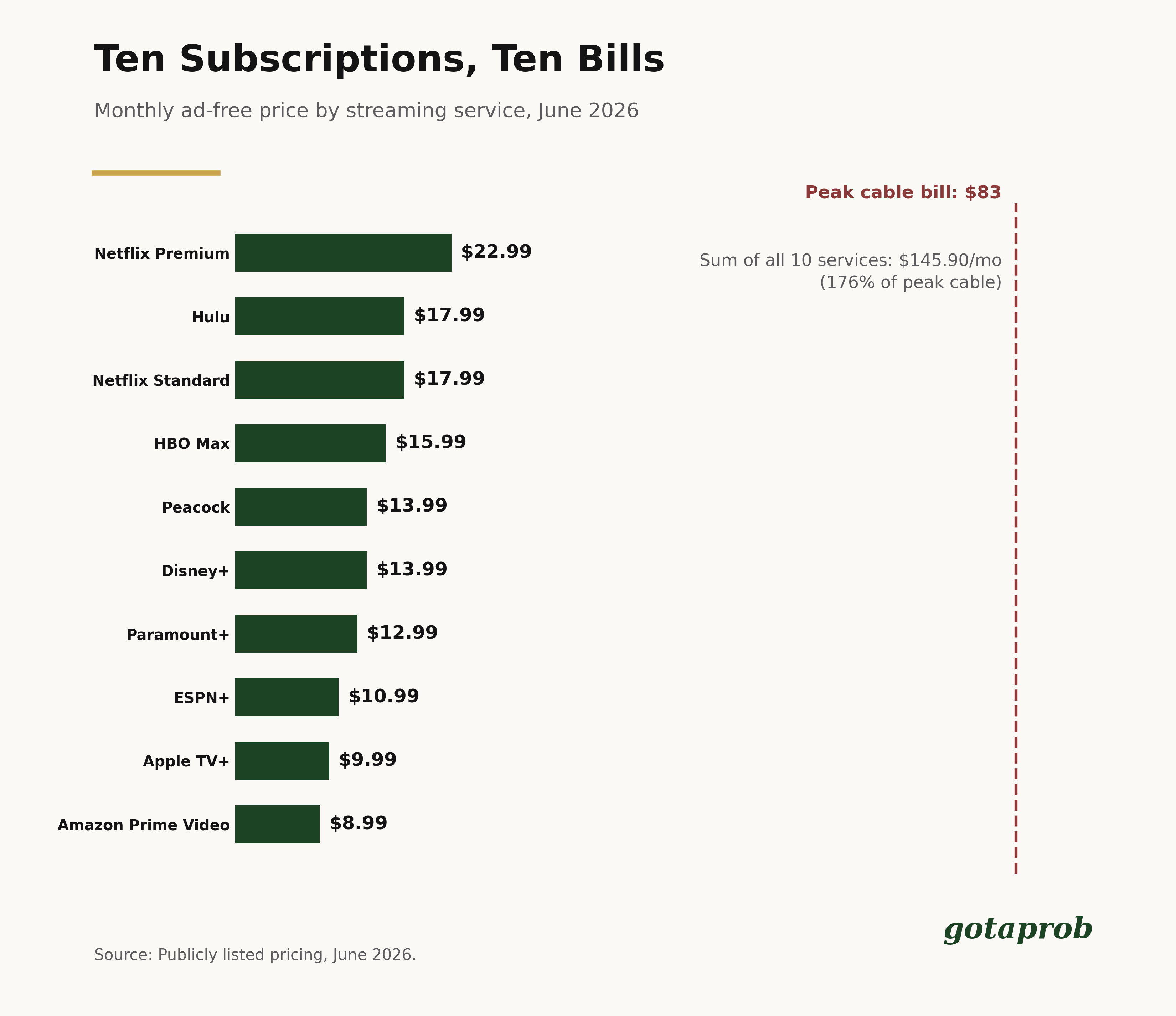
Eight major US streaming services with no ads now cost about $140 per month combined, before taxes, according to a September 2026 streaming price tracker from Yahoo Tech. The average American cable bill at its peak in 2022 was $83 per month according to Statista. Streaming, sold as the cheaper alternative to cable, now costs more than that if you want everything without ads.
What the major services cost in September 2026
These are the no-ads prices for each service:
| Service | No-ads monthly price |
|---|---|
| Netflix (Standard) | $19.99 |
| Max (Premium) | $22.99 |
| Disney+ (Premium) | $21.49 |
| Hulu | $21.49 |
| Peacock (Premium Plus) | $19.99 |
| Paramount+ (Premium) | $13.99 |
| Apple TV | $14.99 |
| Prime Video (ad-free add-on) | $4.99 |
Together that is about $140 per month. Ad-supported plans are cheaper but still add up quickly: most of these services charge $9 to $13 a month for their ad tier, and Prime Video's ad-supported version is included with a Prime membership.
Stay curious
One problem,
every Tuesday.
The most interesting problem of the week, straight to your inbox.
No spam. Unsubscribe anytime.
How prices have moved
Prices have risen sharply in the past year. Netflix's standard plan went from $17.99 to $19.99 in March 2026, and Disney+ and Hulu each rose to $21.49 for ad-free plans in September 2026. Apple TV went up $2 to $14.99 in August 2026. Peacock raised its ad-free Premium Plus plan by $3 to $19.99 in August 2026. Reviews.org's April 2026 analysis found streaming costs rose 18% on average in 2025 alone.
The direction is consistent across every major platform: prices go up, not down.
Why content keeps fragmenting
The fragmentation is structural. When Netflix dominated streaming in 2015 and 2016, major studios were willing to license their content to a single platform. As streaming became more profitable, each studio decided to pull its content and launch its own service instead. Disney pulled its library to launch Disney+. NBCUniversal pulled its content to launch Peacock. Paramount pulled its library to launch Paramount+. Warner Bros pulled its library from Netflix to launch HBO Max.
The result is that content which used to be in one place for one price is now scattered across six to ten platforms each with their own subscription. According to Deloitte's 2026 Digital Media Trends report, the average US household subscribes to 4.5 streaming services, up from 3.4 in 2022. Most households are not subscribing to everything, they are rotating, subscribing for one show, cancelling, and resubscribing elsewhere. That rotation is itself a documented consumer behaviour born directly from the cost of subscribing to everything at once.
For the full breakdown of how streaming fragmentation created a system more expensive than the one it replaced, read the complete gotaprob analysis: Streaming Services Have Fragmented So Much That Watching What You Want Now Costs More Than Cable Ever Did.
Sources
- Yahoo Tech — Streaming Price Hike Tracker, September 2026 no-ads prices for major US services — https://tech.yahoo.com/streaming/articles/streaming-price-hike-tracker-much-155739016.html
- Reviews.org — Why Streaming Costs Are Rising 2026, 18% average price increase in 2025 — https://www.reviews.org/tv-service/why-streaming-costs-are-rising-2026/
- Deloitte — 2026 Digital Media Trends, average US household streaming subscriptions — https://www2.deloitte.com/us/en/insights/industry/technology/digital-media-trends-consumption-habits-survey.html
- Statista — Average US cable bill historical data — https://www.statista.com/statistics/184763/average-cable-tv-bill-in-the-united-states-since-2000/
Go deeper
Streaming services have fragmented so much that watching what you want now costs more than cable ever did