How Do You Know if a Product Is Actually Eco-Friendly?
42% of green claims online are exaggerated, misleading, or false according to the European Commission. There is no single global standard for what eco-friendly means. Here is what to check.
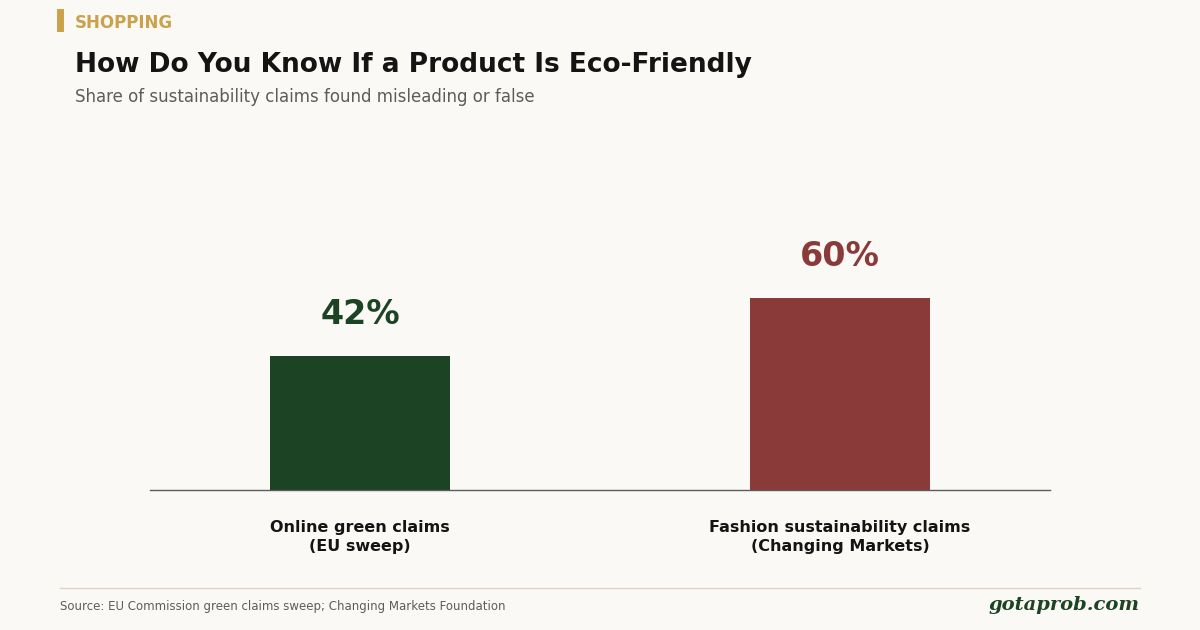
You mostly cannot tell from the label alone. 42% of green claims made online are exaggerated, misleading, or outright false, according to a European Commission sweep of environmental claims across EU member state markets. The term eco-friendly has no legal definition in the United States, no enforceable standard, and no single certification that guarantees what it implies.
Why the label tells you almost nothing
"Eco-friendly," "sustainable," "natural," "green," and "planet-conscious" are marketing terms rather than regulated categories. A company can print any of them on a product without meeting any threshold of environmental performance, without independent verification, and without disclosing what specifically the claim refers to.
The FTC Green Guides, the US Federal Trade Commission's guidelines for environmental marketing claims, advise companies to avoid unqualified general claims like "eco-friendly" because they are too vague for consumers to evaluate. But the Green Guides are guidance, not law. Violations require the FTC to pursue enforcement case by case rather than triggering automatic penalties.
The EU is moving faster. The EU Green Claims Directive, proposed in 2023 and advancing through the legislative process, would require companies to substantiate environmental claims with independent scientific evidence before making them, ban unsubstantiated claims, and impose penalties for violations. Until it is fully enacted and enforced, the situation in Europe resembles the US: claims are common, verification is rare.
Stay curious
One problem,
every Tuesday.
The most interesting problem of the week, straight to your inbox.
No spam. Unsubscribe anytime.
Certifications that actually mean something
Not all green labels are meaningless. Some are backed by specific, independently verified standards:
- Energy Star (US EPA): verified energy efficiency for appliances and electronics
- USDA Organic: independently audited for agricultural and food products
- Forest Stewardship Council (FSC): verified sustainable forestry for paper and wood products
- Certified B Corporation: independently assessed social and environmental performance across the whole company, not just one product
- Cradle to Cradle: materials health and recyclability across the product lifecycle
- Fair Trade Certified: labour and environmental standards for commodity products
Labels without a named certifying body and a published standard behind them are marketing, not verification.
What to check when a specific claim matters
According to the FTC Green Guides, a credible environmental claim should specify:
- What aspect of the product is being claimed (packaging, manufacturing, the product itself)
- What the benefit is compared to what alternative
- Whether it is third-party verified and by whom
A claim that says "made with recycled materials" is more specific than "eco-friendly." A claim that says "packaging made with 30% post-consumer recycled content, certified by [body]" is more specific still. The more specific the claim, the more likely it is grounded in something verifiable.
The scale of the problem
A 2024 analysis by the Changing Markets Foundation found that 60% of fashion industry sustainability claims could not be substantiated or were outright misleading, according to edie's coverage of the report. The fashion industry is often estimated at around 10% of global carbon emissions, a figure the United Nations uses, though other estimates range from roughly 3% to 8% depending on methodology. The exact share matters less than the fact that fashion's environmental claims are rarely checked.
For the full breakdown, read the complete gotaprob analysis: Greenwashing Has Made Every Eco-Friendly Claim Meaningless and Consumers Have No Reliable Way to Verify Impact.
Sources
- European Commission — Screening of websites for greenwashing, 42% of claims misleading or false — https://ec.europa.eu/commission/presscorner/detail/en/ip_21_269
- FTC Green Guides — Environmental marketing guidance and what qualifies as a credible claim — https://www.ftc.gov/news-events/topics/truth-advertising/green-guides
- edie — Report: 60% of sustainability claims by fashion giants are greenwashing, Changing Markets Foundation analysis — https://www.edie.net/report-60-of-sustainability-claims-by-fashion-giants-are-greenwashing/
- United Nations — Greenwashing and deceptive environmental claims — https://www.un.org/en/climatechange/science/climate-issues/greenwashing
Go deeper
Greenwashing has made every eco-friendly claim meaningless and consumers have no reliable way to verify impact