Does Using AI Tools at Work Actually Make You More Productive?
It depends on what productive means. AI speeds up individual tasks but 67% of workers who adopted AI tools in 2025 reported working more hours by year end, not fewer.
AI tools make individual tasks faster. Whether that translates into workers being more productive, in the sense of producing more with less effort or having more time, is a different question. According to UC Berkeley Labor Center research published in February 2026, 67% of workers who adopted AI tools in 2025 reported working more hours, not fewer, by year end. The time AI saves is not returning to the worker. It is being absorbed by higher output expectations.
What the research actually shows
Three major studies published in 2025 and 2026 all point in the same direction:
Harvard Business Review eight-month study of a 200-person US tech company found that employees who used AI tools saved time on individual tasks but that saved time was redirected into more work, resulting in fewer breaks overall. Management raised output expectations once the team demonstrated it could produce more.
Boston Consulting Group survey of 1,488 workers found that the number of AI tools used did not consistently correlate with increased productivity. Researchers named the resulting exhaustion "AI brain fry," the cognitive fatigue of managing multiple AI outputs simultaneously while appearing productive on the surface.
NBER study of 6,000 executives found that two-thirds reported using AI but only for about 1.5 hours per week, with 90% seeing no measurable impact on operations. The people setting output expectations are often the least exposed to how AI actually functions day to day.
Stay curious
One problem,
every Tuesday.
The most interesting problem of the week, straight to your inbox.
No spam. Unsubscribe anytime.
The Ratchet Effect
Harvard Business Review's research named the mechanism precisely. When a team demonstrates it can complete a task in two days using AI instead of ten, management does not grant eight days of recovered time. Management raises the expected output instead.
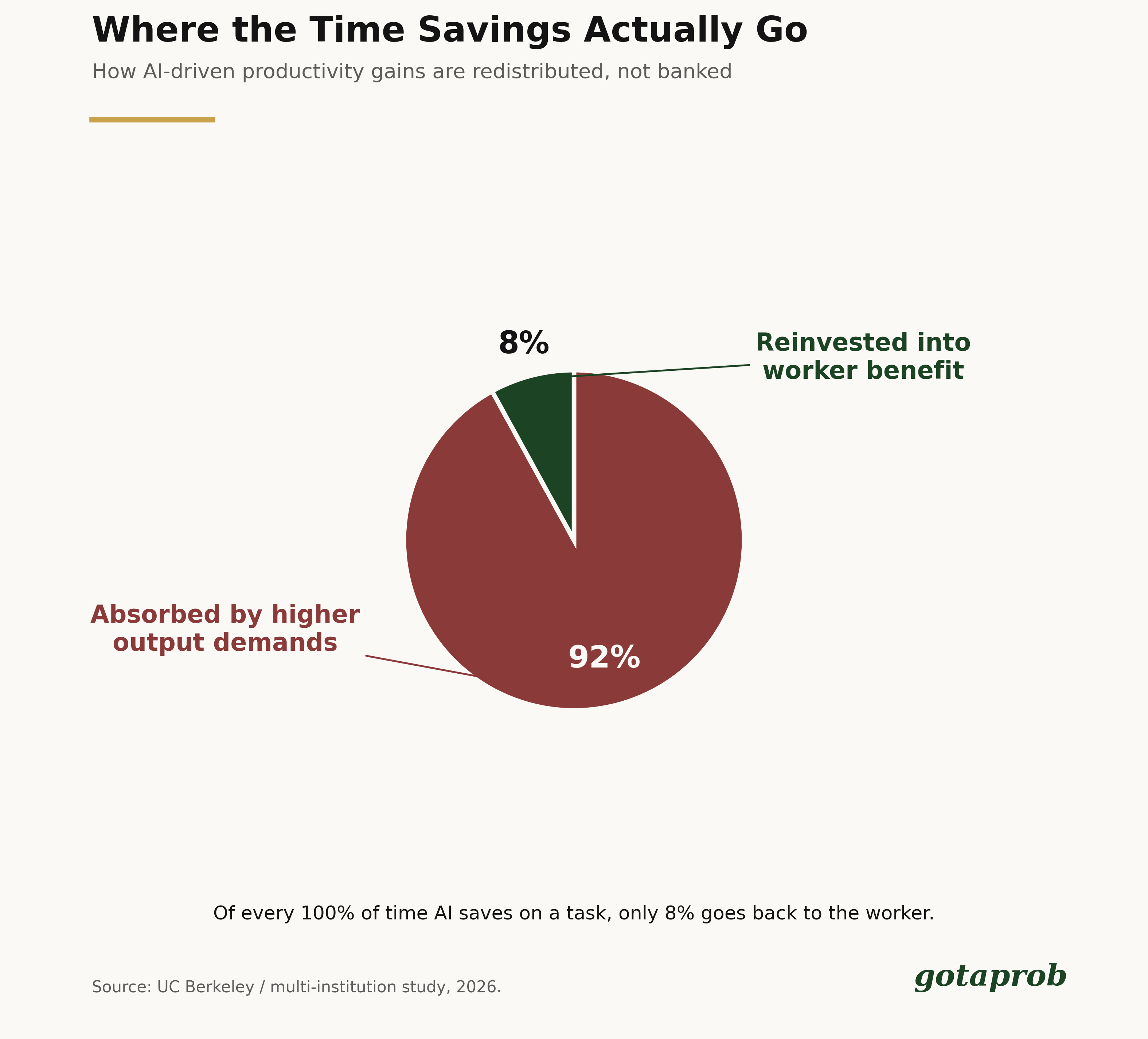
Only 8% of time savings generated by AI tools are reinvested into activities that genuinely benefit the worker, according to multi-institution research cited by AI Magicx's May 2026 analysis. The remaining 92% is absorbed either as increased output demands or consumed by the overhead of managing the AI tools themselves.
Where AI does improve outcomes
The picture is not uniformly negative. A Stanford and MIT randomised controlled trial of 5,179 customer service agents found that AI assistance increased productivity by 14% on average, with the largest gains going to less experienced workers. A separate NBER study found that AI writing assistance increased hires by 7.8% and wages by 8.4% for job seekers.
The difference between these positive outcomes and the broader burnout data is who controls how the time savings are used. In the Stanford and MIT study, agents did not have their quotas raised when AI made them faster. In most workplace settings, they do.
The honest answer
AI makes specific tasks faster. For workers in organisations that capture those time savings as additional expected output rather than returning them as slack time, more productivity means more work with the same or worse quality of working life. For workers in organisations or roles where they control their own output, freelancers, solopreneurs, researchers, AI can genuinely produce more in less time.
The gap between those two situations is not a technology question. It is an organisational incentive question.
For the full breakdown of the AI productivity paradox, the Ratchet Effect, and why the time savings from AI are systematically not returning to workers, read the complete gotaprob analysis: AI Tools Are Supposed to Free Up Your Time but Workers Using Them Report Working More Hours, Not Fewer.
Sources
- Fortune via UC Berkeley — AI future of work research, 67% of workers reporting more hours after AI adoption — https://fortune.com/2026/02/10/ai-future-of-work-white-collar-employees-technology-productivity-burnout-research-uc-berkeley/
- AI Magicx — AI Productivity Paradox 2026, 8% time savings reinvestment figure and Ratchet Effect explanation — https://www.aimagicx.com/blog/ai-productivity-paradox-exhaustion-burnout-2026
- Fortune — AI brain fry BCG study, 1,488 worker survey — https://fortune.com/2026/03/10/ai-brain-fry-workplace-productivity-bcg-study/
- NBER — Stanford MIT customer service AI productivity study — https://www.nber.org/papers/w31161
Go deeper
AI tools are supposed to free up your time but workers using them report working more hours, not fewer, and nobody has fixed the incentive that causes it