Do You Have to Disclose if You Used AI to Build Something?
No law currently requires AI disclosure for most software products. But community norms are moving faster than law, and the backlash for not disclosing can be severe. Here is what the current landscape looks like.
No law in the United States currently requires builders to disclose that they used AI tools to create a software product, app, or digital service unless the product falls into specific regulated categories. However, community expectations have moved significantly faster than law, and the social consequences of non-disclosure can include public backlash, platform removal, and lasting reputational damage for the builder.
Where disclosure is legally required
Legal disclosure requirements for AI use are narrow but growing:
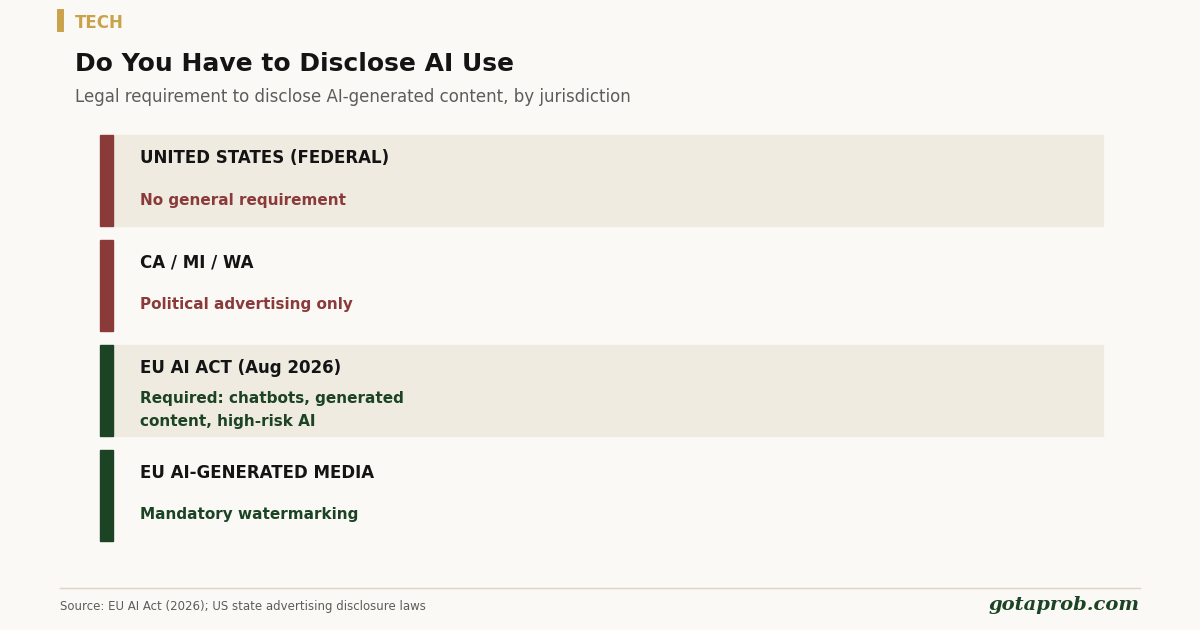
AI-generated content in political advertising: Several US states including California, Michigan, and Washington require disclosure when AI is used to generate content in political advertisements. Federal legislation has been proposed but not passed as of September 2026.
Healthcare and financial products: The FTC has issued guidance that AI-powered health or financial tools must not misrepresent how they work or what drives their recommendations. Calling an AI tool a "doctor's recommendation" or a "certified advisor" when it is AI-generated would violate existing FTC rules against deceptive practices.
EU AI Act (effective August 2026): The EU AI Act requires disclosure when certain AI systems interact with users, including chatbots, AI-generated content, and high-risk applications like credit scoring or hiring tools. Companies serving EU users are now subject to these requirements.
Watermarking under the AI Act: The EU AI Act requires AI-generated images, audio, and video to be clearly marked as AI-generated. Text is not currently covered by mandatory watermarking requirements.
Stay curious
One problem,
every Tuesday.
The most interesting problem of the week, straight to your inbox.
No spam. Unsubscribe anytime.
Where there is no legal requirement but strong community expectation
For software products, apps, and tools built using AI coding assistants like Cursor, Claude Code, or GitHub Copilot, no US law requires disclosure. The product is yours regardless of which tools you used to build it, in the same way that a contractor who builds a house with power tools is not required to disclose that they did not use hand tools.
Community norms are different. According to TechCrunch's March 2026 coverage of the vibe coding backlash, a significant portion of the builder and developer community views non-disclosure as deceptive when a product is presented as the sole creative and technical output of the builder. Hacker News and Product Hunt discussions about AI-built products routinely include demands for disclosure, and products discovered to have been AI-built after claiming otherwise receive disproportionate negative attention.
The documented backlash cases show a consistent pattern. The problem is rarely that AI was used. The problem is that AI use was concealed while the builder implied solo technical authorship.
The security dimension that changes the calculus
The vibe coding security research published in 2026 adds a practical reason to disclose that goes beyond social norms. Aikido Security found that 40% to 62% of AI-generated code contains security vulnerabilities, and 91.5% of vibe-coded applications had at least one AI hallucination-related vulnerability in Q1 2026.
Users of a product built entirely with AI tools have a reasonable interest in knowing that, because it affects the security posture of the product they are trusting with their data.
What the community considers reasonable disclosure
Based on the documented norms across Product Hunt, Hacker News, and indie hacker communities:
- Saying "built with the help of AI tools" is generally well received
- Saying "100% AI-generated, I wrote zero code" is sometimes praised for honesty and sometimes criticised depending on context
- Saying nothing and then being discovered to have used AI extensively is consistently poorly received
- Saying "I built this" when AI wrote the majority of the code is what generates the most significant backlash
For the full breakdown, read the complete gotaprob analysis: Builders Who Share Projects Made With AI Assistance Face Public Backlash With No Clear Standard for What Disclosure Is Actually Expected.
Sources
- TechCrunch — Vibe coding backlash and AI disclosure norms March 2026 — https://techcrunch.com/2026/03/15/vibe-coding-backlash-builders-ai-disclosure/
- Aikido Security — AI-generated code security risks 2026, vulnerability rates in vibe-coded applications — https://www.aikido.dev/blog/ai-generated-code-security-risks-2026
- EU AI Act — Official text and transparency requirements effective August 2026 — https://artificialintelligenceact.eu/the-act/
Go deeper
Builders who share projects made with AI assistance face public backlash with no clear standard for what disclosure is actually expected